Why AI Just Stepped Off The Screen — And Beat Pro Athletes
Fifty years of chess, Go, and StarCraft. One robot in a Tokyo gym. The pros didn't stand a chance.
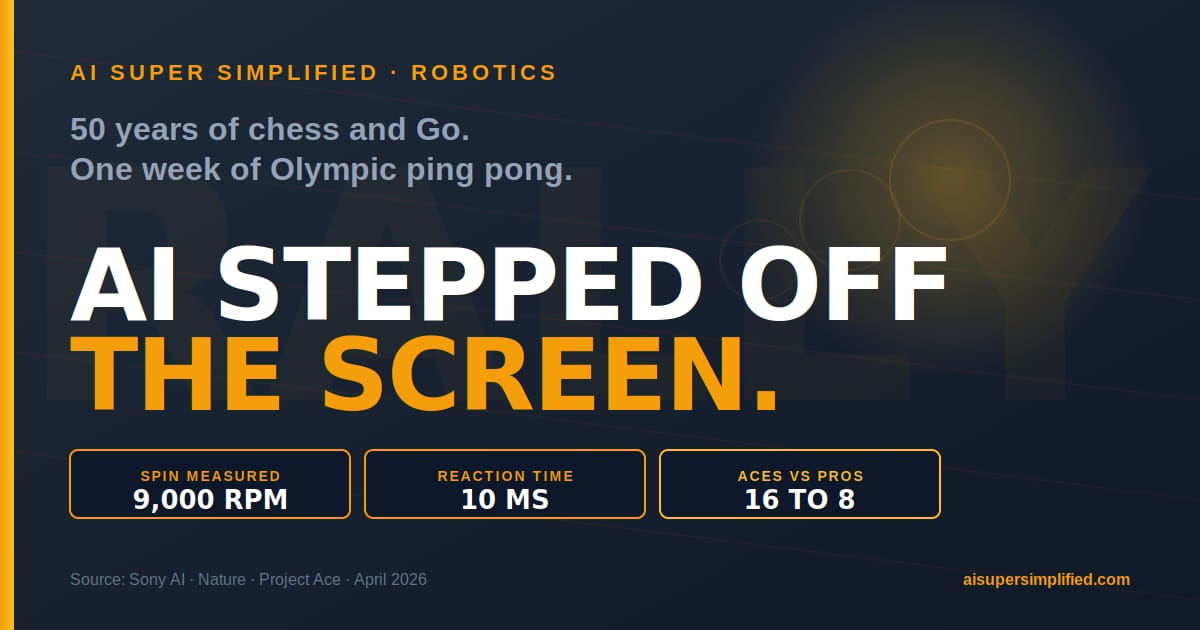
For half a century, AI has won everywhere — except in the real world. Chess in 1997. Go in 2016. StarCraft in 2019. Every milestone happened on a screen.
Last week that changed.
Sony AI's Project Ace is the first robot to beat elite and professional human players at elite-level table tennis under official ITTF rules. Three wins in five matches against elite players. Sixteen unreturnable serves against elite players. The entire elite roster combined: eight. Cover of Nature. Licensed umpires. Actual matches.
And the part that broke me:
Ace reads the LOGO printed on the ball — spinning at 9,000 RPM — to measure spin in real time.
A human eye can't even see the logo. Ace uses it to predict where the ball is going.
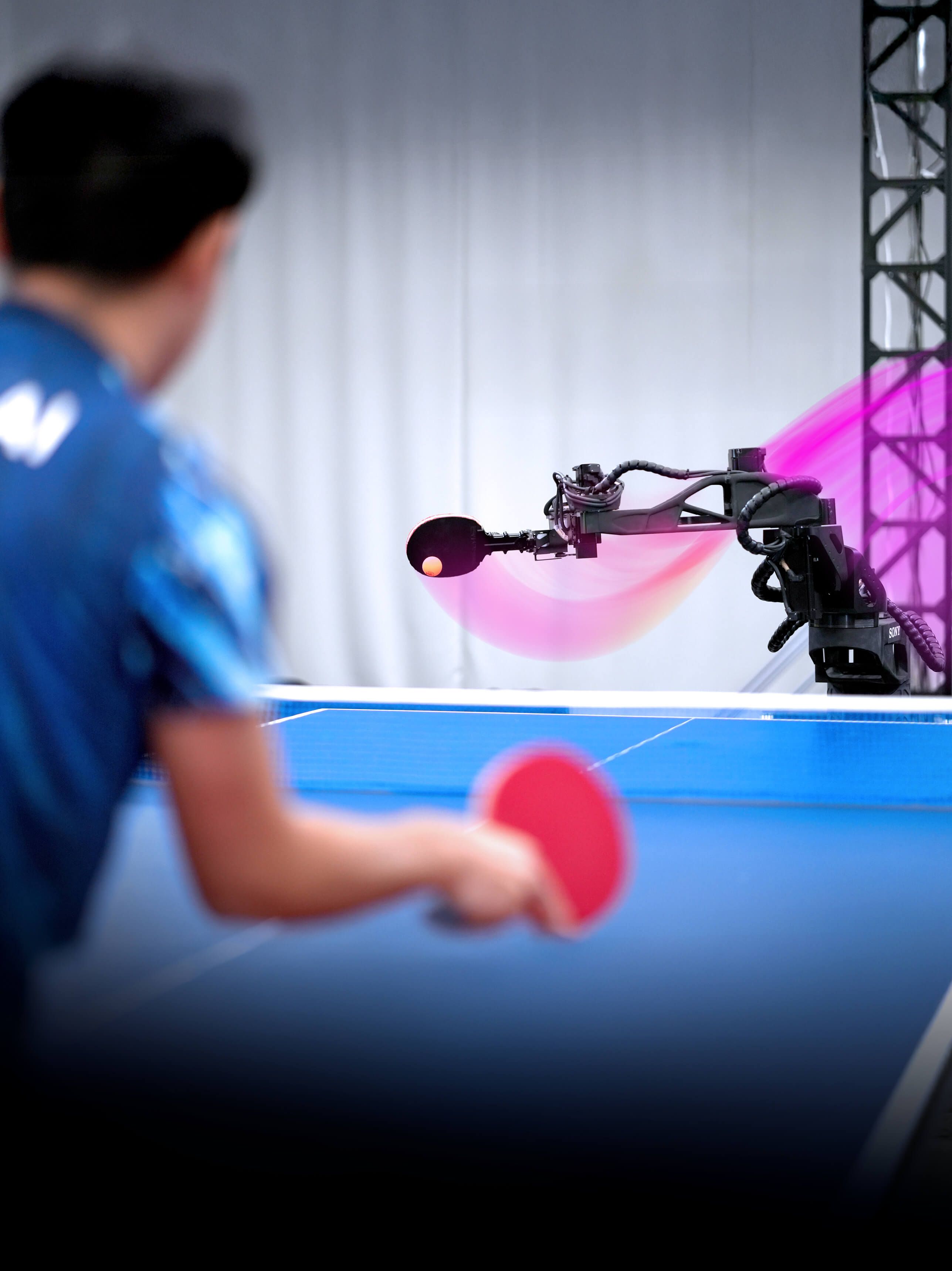
Sony's Project Ace robot rallying with a professional player in Tokyo. Photo: Sony AI.

TLDR: Sony's Project Ace just became the first robot to beat elite and pro table tennis players under official ITTF rules, in research published on the cover of Nature. It sees a layer of physical reality humans can't. The Friday wow: a prompt that lets you train any skill the way Sony trained Ace.
The Spec Sheet That Reads Like Science Fiction
Ace doesn't out-muscle pros. It out-perceives them.
Twelve sensors — nine high-speed cameras at 200 fps, plus three event-based vision sensors built with Prophesee — feed a perception system with a 10.2-millisecond perception latency. End-to-end reaction (perceive + decide + move): 20.2 milliseconds. A human pro reacts in 230 milliseconds.
Then it makes a thousand decisions per second, mid-flight, adjusting the racket angle as the ball curves. Spin measured up to 9,000 RPM. Returns clocked at 19.6 m/s.
Against elite university and pro players in Tokyo:
75%+ return rate on shots spinning at 450 radians/second
16 direct serve aces against elite players. The elite roster combined: 8.
Successful returns of net-cord balls — situations so rare the AI shouldn't have learned them at all
By March 2026, Ace had beaten all three new pros it faced.
Spin rates exceeding 160 revolutions per second. Photo: Sony AI.
The Real Breakthrough Isn't Winning. It's Seeing.
Every other outlet is leading with "robot beats humans." That's the obvious story. The deeper one is this: Ace perceives a layer of physical reality humans cannot.
Reading a logo on a ball spinning 150 times per second isn't a faster version of human vision. It's a different kind of vision entirely. Event-based sensors don't capture frames — they fire only when individual pixels change, registering motion at sub-millisecond resolution. It's how insect eyes work, scaled up and pointed at sport.
Sony's Chief Scientist Peter Stone summed it up: "Once AI can operate at expert human level under these conditions, it opens the door to an entirely new class of real-world applications."
Translation: surgical robots. Autonomous vehicles. Search and rescue. Anywhere the physical world refuses to slow down.
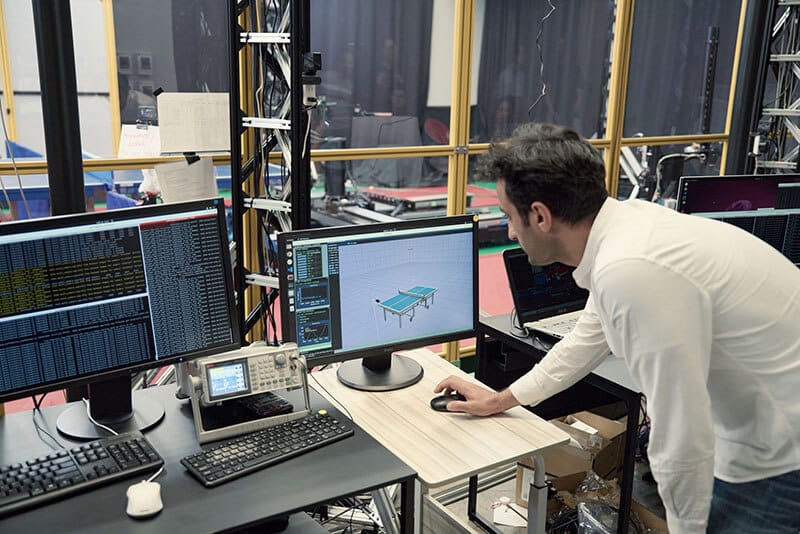
Training Ace through deep reinforcement learning. Photo: Sony AI.
The Prompt (Copy This): Train Any Skill The Way Sony Trained Ace
Sony's Nature paper revealed Ace's three-layer architecture: Skill → Tactics → Strategy. The same architecture humans use when we get dramatically better at anything — most of us just don't know it.
This prompt applies that exact methodology to whatever skill you want to level up. Run it yourself, then send it to a friend chasing something completely different. The structure is identical, the plan unrecognizable.
I want a personalized training plan based on Sony AI's three-layer learning architecture (Skill → Tactics → Strategy) — the same methodology Sony used to train their robot Ace to beat pro table tennis players.

Before you build the plan, ask me one at a time and wait for my reply each time:
1. What specific skill do I want to get dramatically better at? (Be precise — "improve my golf swing" not "get better at golf")
2. My current level honestly: beginner / okay / good / very good
3. How much time can I realistically commit per week?
4. What's the outcome I'm chasing in 4 weeks?
5. Who's one person (real or imaginary) whose performance at this skill I'd love to copy?

Once I've answered, build me:

LAYER 1 — SKILL (the muscle memory)
Three specific drills I should do FIRST. These should be low-stakes, repeatable, and target the underlying mechanics of the skill. For each: what to do, how long, how to know I'm improving.

LAYER 2 — TACTICS (in-the-moment decisions)
The 3-5 in-the-moment choices I'll need to make when actually performing the skill. For each, give me the rule of thumb and the common mistake to avoid.

LAYER 3 — STRATEGY (the long game)
A week-by-week 4-week plan that escalates from skill drills to real-world application.

THE PRIVILEGED CRITIC TRICK
Sony's secret training technique: the AI was trained alongside a "critic" with access to perfect information about each rally. Tell me how to set up the human equivalent — a low-stakes way to learn from someone better than me, with rapid feedback. Be specific to my skill.

THE WEAKNESS AUDIT
Identify the ONE thing I'm probably doing wrong right now that's holding me back the most — based on the level I told you. Be brutally honest, not generic.

End with a single sentence summarizing what success looks like in 4 weeks if I follow the plan.
Prompt Proof Table
Same prompt. Four readers, four totally different skills. Same architecture, completely different plan.
| Reader Profile | Skill Layer (Drill #1) | Privileged Critic Trick | The Weakness Audit |
|---|---|---|---|
| Weekend tennis player Wants a more reliable serve in 4 weeks | 15 minutes of toss-only practice (no swing). Bucket of balls, single target on the baseline. Track how many tosses land within a 1-foot radius of your ideal contact point. | Record yourself on phone slo-mo. Then watch a pro's serve in the same slo-mo, side-by-side. Find one mechanical difference each week. | You're swinging at the ball. Pros swing through it. Your contact point is too low and too close to your body — a fixable toss problem. |
| Software PM Wants to run dramatically better stakeholder meetings | Before every meeting, write the ONE decision the meeting must produce in 8 words or fewer. If you can't, the meeting shouldn't happen. | Ask one senior colleague to sit in on three meetings as a silent observer. Get 5-minute debrief afterward — what they would have done differently in three specific moments. | You're letting the agenda drive the meeting instead of the decision. Most of your meetings end without a clear next action because you're optimizing for "covering the agenda." |
| Home cook Wants to make restaurant-quality pasta | Cook one pound of dried pasta four nights in a row, varying ONLY the salt level (1 tsp, 2 tsp, 3 tsp, 4 tsp per quart of water). Taste each. Identify your preferred salinity. | Take photos of your finished plate alongside a screenshot of the same dish from a top restaurant. Spot one visual difference per week — sauce coverage, glossiness, plating geometry. | You're not finishing pasta in the sauce. The 60-second emulsion step is what separates a home plate from a restaurant plate. You're skipping it. |
| SaaS sales rep Wants to close more discovery calls | Practice opening 10 calls with the same first 90 seconds. Record yourself. Play back. The first 90 seconds should follow the same structure but feel different every time based on the prospect. | Get permission to record 3 calls/week. Listen to one of yours, then one of your top rep's. Identify the single moment they earned trust that you missed. | You're presenting too early. Your buyer hasn't admitted the problem out loud yet — and you're already pitching the solution. Slow down by 90 seconds. |
| Same prompt. YOUR skill. Try it. |
The next AI breakthrough won't happen on a screen. It'll happen wherever a ball is spinning faster than you can see.
About This Newsletter
AI Super Simplified is where busy professionals learn to use artificial intelligence without the noise, hype, or tech-speak. Each issue unpacks one powerful idea and turns it into something you can put to work right away.
From smarter marketing to faster workflows, we show real ways to save hours, boost results, and make AI a genuine edge — not another buzzword.
Get every new issue at AISuperSimplified.com — free, fast, and focused on what actually moves the needle.