Why GitHub Isn't Just for Coders Anymore
AI writes the code now, so the only skill that still matters is knowing where work lives.
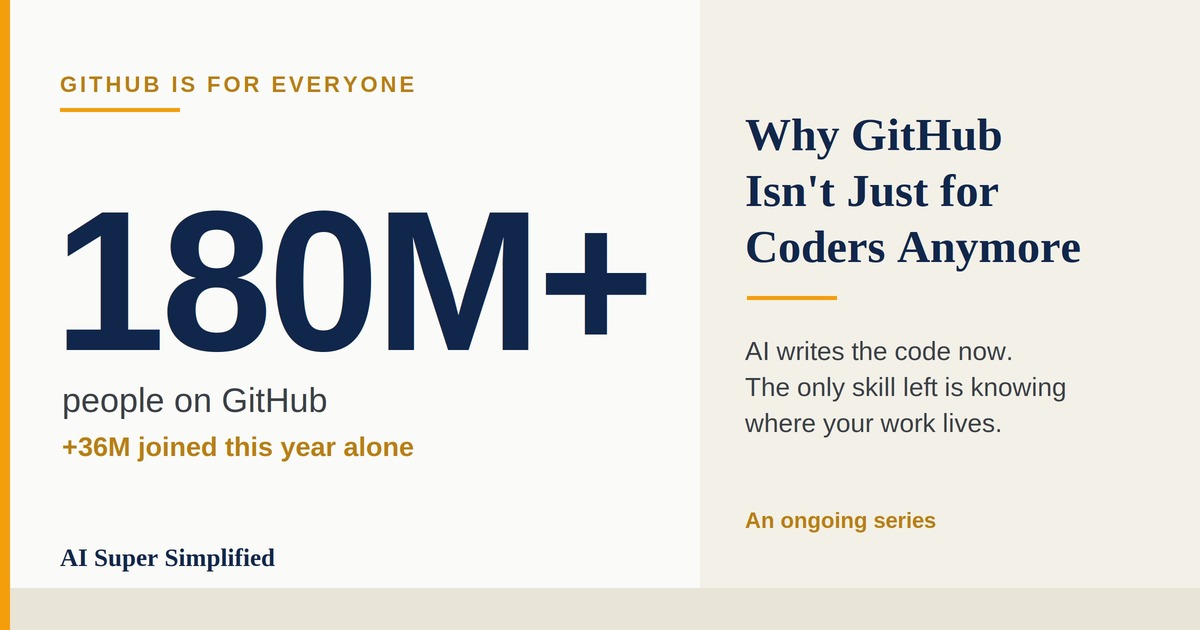
GitHub Is for Everyone — the most useful tool you've never opened, explained one feature at a time. An ongoing series.
AI writes the code now, so the only skill that still matters is knowing where work lives. We're kicking off an ongoing series to hand you that, one piece at a time. First up: the single idea that unlocks everything.
Every second, on average, a new person joins GitHub. More than 36 million signed up this past year alone, pushing the total past 180 million — the fastest growth in the platform's history. GitHub counts every one of those people as a “developer.” But here's the quiet part: on GitHub, a “developer” is simply anyone with an account. Not anyone who can code. Anyone.
That gap — between what GitHub is famous for and who it's actually for now — is the whole story. And it's great news for you.
The reputation is out of date
For nearly two decades, GitHub had one job in most people's minds: the place programmers stash their code. If you didn't write software, you closed the tab. Fair enough — but two things flipped.
First, AI started writing the code. You can describe a tool, a website, or an automation in plain English and get something that actually works — and that work has to live somewhere. Second, people finally noticed that the engine underneath GitHub was never only about code. It's about keeping perfect track of things. And it is unfairly good at it.
Today's feature: the repository
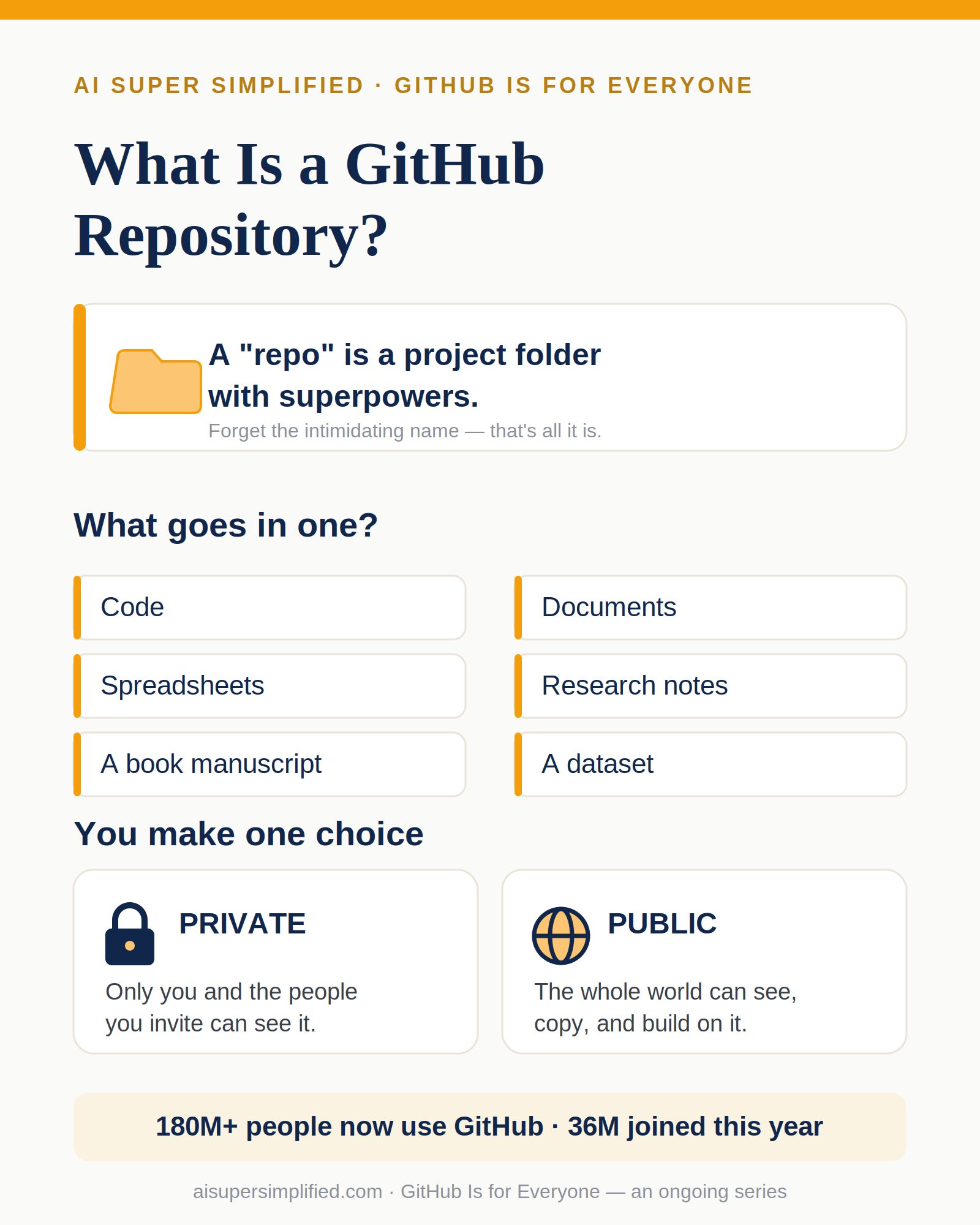
Everything on GitHub starts with a repository — “repo” for short. Forget the intimidating name. A repo is just a project folder that happens to have superpowers.
What goes in one? Code, sure. But also documents, spreadsheets, research notes, a book manuscript, a dataset, a recipe collection. If it's a project, it can be a repo.
You make exactly one choice that matters: private or public.
- Private means it's yours. Only you and the people you specifically invite can see it. Most people's first repos are private — a safe, backed-up home for one project.
- Public means the whole world can see it, copy it, and build on it. That sounds nerve-racking until you realize it's the exact mechanism behind nearly every free tool, template, and open-source project you already rely on.
That's the on-ramp. A repo is a folder you can keep as private as a diary or open as a billboard. And the moment your project lives in one, the real magic switches on: a complete, rewindable history of everything that ever happened to it.
Why this matters now
If you're using AI to make anything — and more and more, you are — GitHub is where that work naturally lands. Your AI assistant already speaks its language fluently. Knowing your way around it stopped being a programming skill; it's becoming a basic literacy, like knowing what a folder is.
You don't have to write a single line of code to get enormous value from a tool that never forgets and never loses your work.
Coming up in this series
Next, we open the time machine: commits — the save point that never overwrites the last one, so nothing you make is ever truly lost. After that, one feature at a time: branches, a built-in to-do list, copying anyone's work with one click, turning a repo into a live web page — and eventually a running list of the best repos worth bookmarking even if you never touch code.
The door's been open the whole time. We're just walking you through it.