Why Claude Just Handed You a Free AI Coach
Edition 276 — Anthropic's new Reflect feature turns your chat history into a personal AI fluency audit

Most people treat AI chat history like a browser cache — something that just piles up in the background. Anthropic just turned that pile into a coaching report.
The new feature, called Reflect, is live in beta under Settings on web and desktop (mobile is coming later). It's easy to undersell as a “Spotify Wrapped for AI chats,” but that comparison misses the point. Wrapped tells you what you did. Reflect tells you how to do it better.
How Reflect actually works
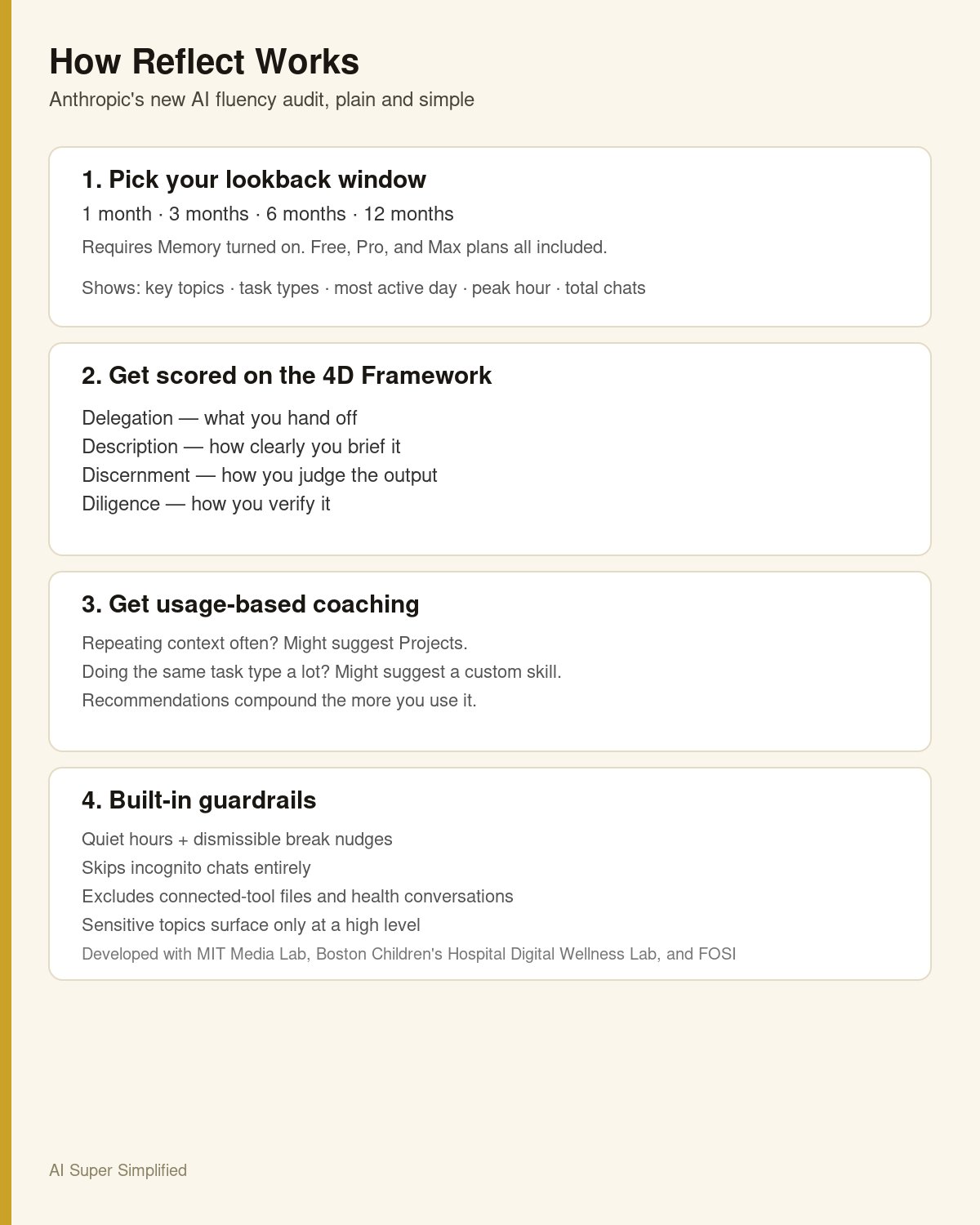
With Memory turned on, Reflect looks back across a window you choose — one, three, six, or twelve months — and surfaces the shape of your usage: your key topics, the kinds of tasks you delegate most, your most active day, your peak hour, and your total chat count. Anthropic deliberately left time-spent metrics out for now, according to the company's head of wellbeing policy — that number is coming in a future update, once they're confident it won't just become another stat to obsess over.
The real value: usage-based coaching
The real value sits underneath those numbers. Reflect scores your usage against a 4D AI Fluency Framework — Delegation, Description, Discernment, and Diligence — and then coaches you on the gaps. If you're repeating the same context in chat after chat, it might point you toward Projects. One early reviewer at Engadget got a suggestion to build a custom fact-checking skill, based on a pattern in how they were already using Claude. That's the shift: instead of a static summary, you get usage-based recommendations that compound over time.
Privacy and guardrails matter here
Anthropic built in guardrails, too. Quiet hours and dismissible break nudges are part of the package, aimed at keeping usage healthy rather than just habitual. On privacy, Reflect skips incognito conversations entirely, excludes anything tied to connected tools or files, keeps health-related conversations out of scope, and only surfaces sensitive topics at a high level rather than in detail. The feature was built with input from the MIT Media Lab's Advancing Human-AI Interaction initiative, the Digital Wellness Lab at Boston Children's Hospital, and the Family Online Safety Institute — a notably deliberate approach for a feature that's essentially reading your usage patterns back to you.
If you've been using Claude for a while without much structure — no Projects, no custom instructions, just chat after chat — Reflect is worth a look. It's less a report card and more a mirror that also happens to give advice.
One heads-up: Reflect is rolling out gradually, so it may not show up in your Settings yet even if you're on a paid plan with Memory turned on. If you don't see it, there's nothing to configure — just check back in the coming days. In the meantime, the prompt below gives you the same audit, right now, in any chatbot.