12,637 Real AI Conversations Later, Here's What People Actually Ask It For | Edition 282
Edition 282 — A new study of real AI conversations found its #1 use, two years running, has nothing to do with spreadsheets.
Ask most people what AI is "for" and you'll get spreadsheets, code, and customer service bots. Ask 12,637 real AI users what they actually used it for last year, and the answer is stranger. The single most common use of AI in 2026, for the second year running, is therapy and companionship. Not code. Not spreadsheets. Someone to talk to.
That's the headline finding from "AI in the Wild," the third annual study by researchers Marc Zao-Sanders and Sara Biuk, published in Harvard Business Review. Instead of asking people what they say they do, the researchers scraped real, self-reported use cases off Reddit, Quora, LinkedIn, TikTok, YouTube, and news articles between March 2025 and February 2026, then used a hybrid human-AI system to classify all 12,637 of them. It's about as close as anyone has gotten to a ground-truth record of what people actually type into AI chatbots, instead of what marketing decks claim they type.
What actually rose, fell, and showed up for the first time
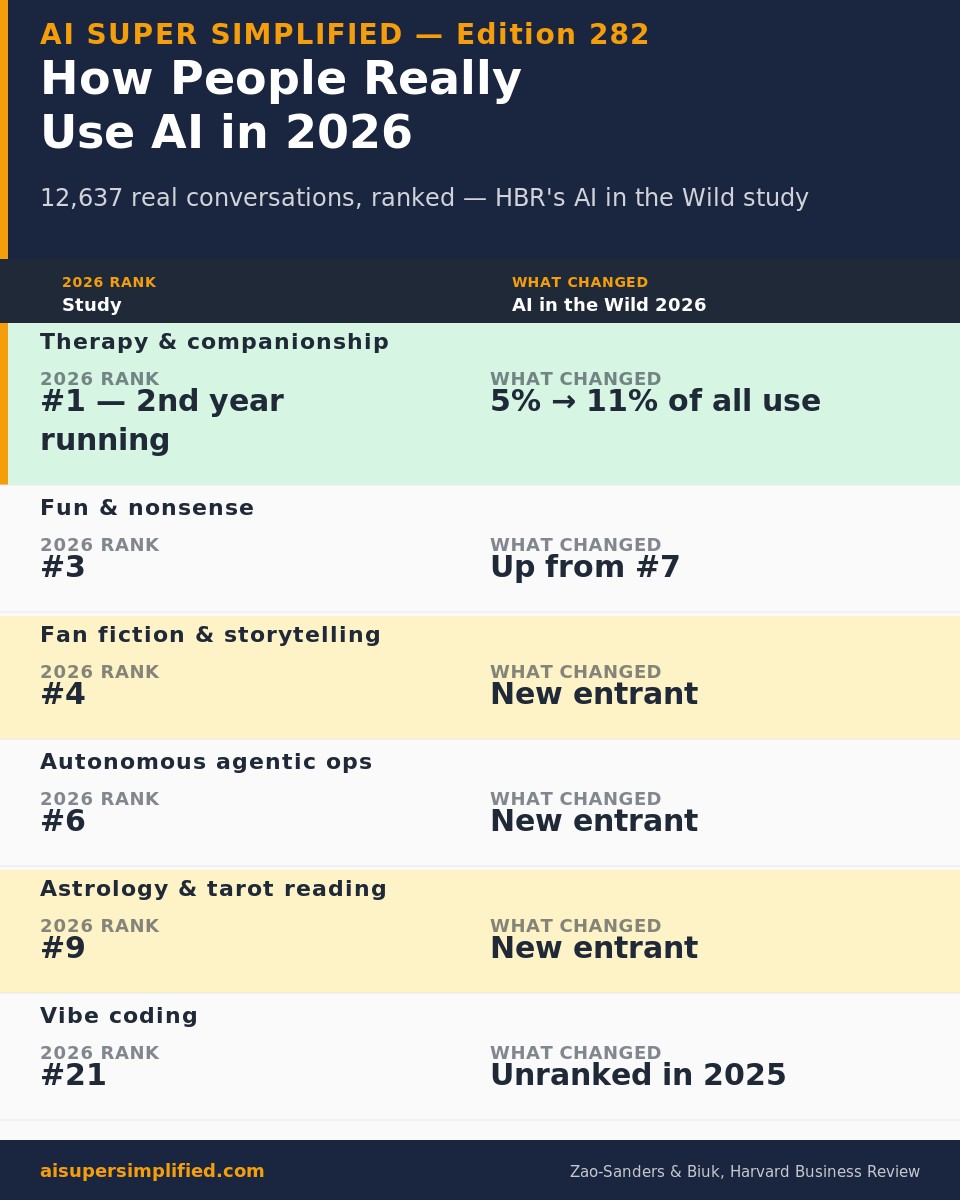
The study ranks the top 100 real-world AI use cases every year, and 2026's list moved more than usual. "Fun and nonsense" — the catch-all for goofing around — jumped from 7th place to 3rd. Fan fiction and storytelling debuted at #4. Astrology and tarot reading showed up for the first time ever, at #9. Vibe coding — regular people prompting a working app into existence without knowing how to code — didn't rank at all last year and sits at #21 now. See the full movement in the table below.
The specific, real things people are doing with it
None of this is hypothetical. Here's what's actually happening, sourced and named:
- Asking it for relationship advice before a hard conversation with a partner, then having the real conversation differently — now the 7th most common use case in the world.
- Venting to it like a coworker between meetings. The study's new "work buddy" category climbed straight to #8.
- Setting it loose on a multi-step task, unsupervised. "Autonomous agentic operations" is a brand-new top-10 entrant at #6.
- Getting an astrology or tarot reading from a chatbot instead of a person — new to the list this year, debuting at #9.
- Prompting an entire working app into existence without knowing how to code. "Vibe coding" didn't rank at all last year; it's #21 now.
- Co-writing fan fiction with a chatbot as scene partner — a brand-new #4, ahead of most "serious" business categories.
- Roleplaying as a Dungeon Master or an original character on chat-companion apps like Character.AI, purely for fun.
- Talking daily to a companion app like Replika — sometimes instead of texting an actual person.
- Watching AI-generated "reality shows," with characters and plotlines that never existed — a new entrant at #11, one spot outside the top 10.
- Asking a chatbot to draft a eulogy or a full funeral speech — common enough that several small startups now exist to do only that.
- Having it write wedding vows or a best-man toast.
- Practicing a hard real-life conversation first — quitting a job, coming out, asking for a raise — as a private roleplay before doing it for real.
- Writing a resignation letter, or a breakup text, that never actually gets sent.
- Building an entire parody of an AI chatbot — staffed by real humans typing the answers by hand. One teenager's joke site, "Your AI Slop Bores Me," pulled more than 25 million unique visitors in about a month.
- Getting genuinely competent coding help, which barely made news this year precisely because it's stopped being surprising — "technical use/software" is still a top-5 category.
- Asking AI to check its own prior answer before trusting it. Decision support and self-checking both climbed in this year's rankings.
And the pattern the researchers flagged as the real story, cutting across nearly every category above: at least a quarter of this year's top use cases involve people asking AI to do a slice of their actual thinking — not their typing — for them. Zao-Sanders coined a name for it: "thinkslop."
| Use case | 2026 rank | What changed |
|---|---|---|
| Therapy & companionship | #1 (2nd year running) | Share nearly doubled: 5% → 11% |
| Fun & nonsense | #3 | Up from #7 |
| Fan fiction & storytelling | #4 | New entrant |
| Technical use / software | #5 | Climbed into the top 5 |
| Autonomous agentic operations | #6 | New entrant |
| Relationship advice | #7 | — |
| "Work buddy" | #8 | New category |
| Astrology & tarot reading | #9 | New entrant |
| Fake reality TV | #11 | New entrant, missed top 10 |
| Vibe coding | #21 | Unranked in 2025 |
What this means for you
You're already the exception. If you're reading a newsletter about using AI deliberately for work, you're ahead of the single largest use case in the world, which is basically "someone to talk to."
Thinkslop is a discipline problem, not a tools problem. The fix isn't a better prompt — it's noticing the moment you're about to skip your own thinking, and doing five minutes of it anyway before you hand the rest to AI.
The technology didn't get more serious this year. Its 12,637 real users just got more honest about what they actually use it for.