$300 Billion to $1 Trillion in Two Years. Even Jamie Dimon Won't Name the Winner. | Edition 338
Edition 338 — The AI buildout could add about 1% to U.S. GDP a year. America's biggest banker says the dot-com bust is the map.
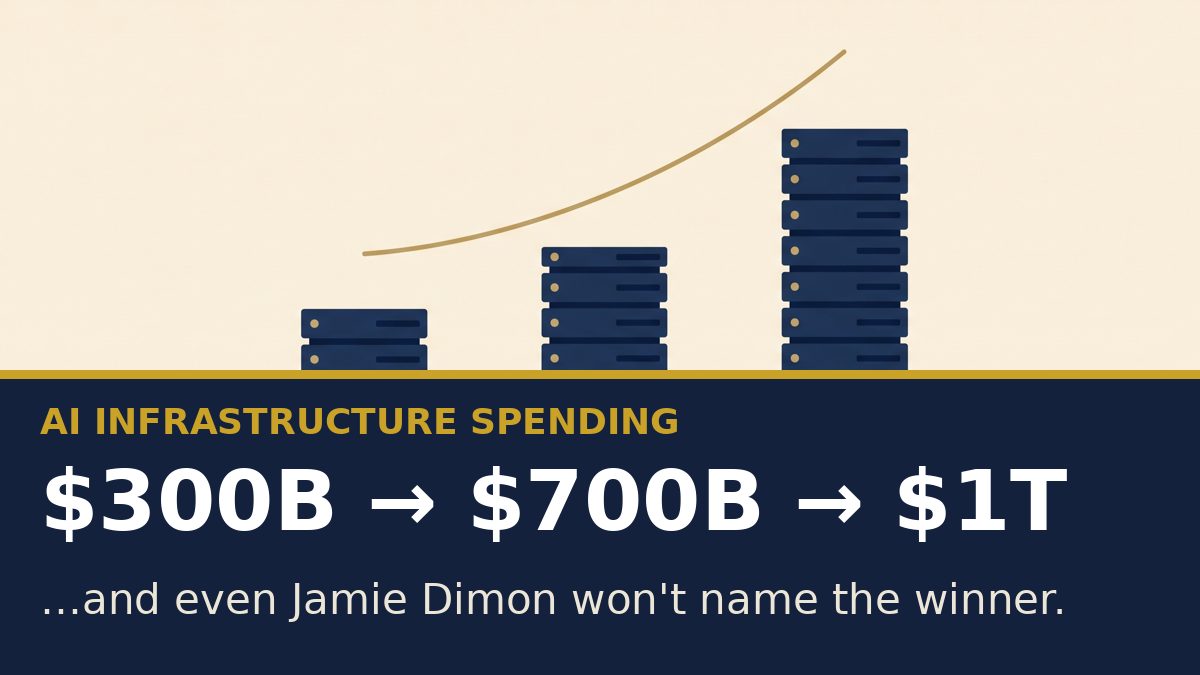
On Monday, Jamie Dimon — who runs JPMorgan Chase, the biggest bank in America — put a price tag on the AI buildout. About $300 billion last year. About $700 billion this year. Possibly $1 trillion next year.
“That’s like 1% increase to GDP each year,” he told CNBC-TV18. Then he said the sentence that deserves more attention than the trillion: it is too early to know who wins. His reference point was the internet bubble — the boom that built the modern web and wiped out many of the companies that paid for it.
What Dimon actually said
Dimon was speaking on the sidelines of the 11th annual JPMorgan India Conference. His number covers what he called the hyperscaler ecosystem — the giant cloud companies like Amazon, Microsoft, Google and Meta, plus everyone selling them chips, power, equipment and land. That spending, he said, more than doubled in a single year, from roughly $300 billion to roughly $700 billion, and could reach $1 trillion in 2027.
He was clear that this cuts both ways. In the short run, he said, it may add a little to inflation, because companies are hiring people, building factories and power plants, and buying equipment and copper wire. In the long run he expects AI to push prices down, calling it an “unbelievable technology” whose expansion looks set to continue.
Asked whether companies can prove a return on all of this, he said return on investment is not always the test — sometimes a technology is simply “table stakes,” the price of staying in the game. He also said there may be a market correction, though he was not sure AI would be what causes it, and that heavy borrowing for infrastructure, defense and government deficits is pushing interest rates up.
Check the math: is this really 1% of the economy?
Mostly, yes. The U.S. economy produced about $30.8 trillion in 2025, so 1% is roughly $300 billion. The jump from $300 billion to $700 billion is $400 billion of new spending in one year — about 1.3% of the whole economy. Another $300 billion on top in 2027 would be roughly another 1%. Dimon’s shorthand holds up.
His figure is not an outlier either. S&P Global Ratings projects that six companies alone — Alphabet, Amazon, Microsoft, Meta, Oracle and SpaceX — will go from about $470 billion in capital spending in 2025 to $870 billion in 2026 and more than $1.3 trillion in 2027. Different lists of companies produce different totals, but every count points the same way.
The clearest sign comes from the government’s own books. In the second quarter of 2026, inflation-adjusted U.S. spending on information-processing equipment — computers, servers, data-center hardware — reached $752 billion, edging past the $748 billion of residential investment, according to Bureau of Economic Analysis data reported by Fortune. Housing investment is down 18% from its early-2021 peak; computer spending is up 51% over the same stretch. America now spends more building computers than building homes.
The sentence that matters more than the trillion
Dimon did not say the money is wasted. He said nobody can tell yet who it will pay off for — and he pointed to the internet bubble as the pattern, when many of the famous names failed and companies few people had heard of became the giants.
That history has a detail worth remembering. In the late 1990s, telecom companies raced to lay fiber-optic cable across continents and under oceans. Many of them went bust — Global Crossing, which built one of the largest undersea networks, filed for bankruptcy in January 2002. The cable stayed in the ground, and it became part of the cheap bandwidth the modern internet runs on. The builders lost. The users won.
There are early signs of the same squeeze. S&P Global Ratings says these companies’ spending is growing faster than their revenue, warns of overcapacity if demand disappoints, and expects the six to spend more than their operations bring in during 2026 and 2027, with 2028 as the year revenue is supposed to catch up. The buildout also has neighbors: in a recent NBC News poll, 64% of registered voters said they would be less likely to support a candidate who backs building a data center in their community.
What a $1 trillion buildout means for you
Your AI tools should keep getting cheaper and better. A capacity race tends to favor the people renting the capacity. That is Dimon’s long-run deflation point, and it is the fiber story again: when the builders overbuild, users get more for less.
Your bills may feel it first. Dimon’s own caveat is a little more inflation now and upward pressure on interest rates. Data centers compete for the same workers, equipment, copper and power as everyone else.
Your retirement account is probably already in the bet. If you own an S&P 500 index fund, the companies writing the biggest checks — Microsoft, Alphabet, Amazon and Meta — are among its largest holdings. That is not a reason to buy or sell anything. It is a reason to know what you own. (Not financial advice.)
Who spends the most is not who wins. That is Dimon’s warning, compressed. Watch who turns the spending into things people pay for, not who announces the biggest number.
A trillion dollars is real money, and the demand behind it is real too. What is not settled — by Dimon’s own account — is who gets paid back. The last time the world overbuilt the plumbing of a new technology, the people who used it came out ahead of the people who built it. That is not a bad side of the bet to be on.