Uber Put AI Use on a Leaderboard. The Year's AI Budget Was Gone by April. | Edition 351
Edition 351 — AI agents can use 5 to 30 times more tokens than a chatbot. Here are four ways to cut the bill.
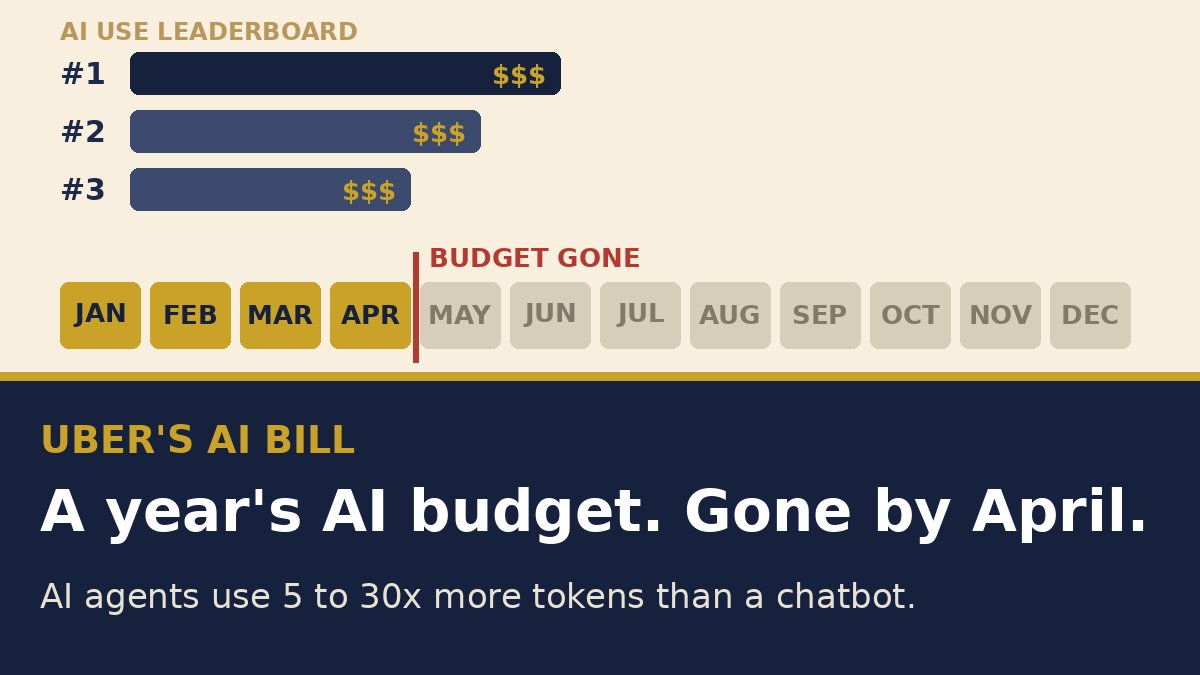
Uber wanted its engineers using AI. It got exactly that.
The company gave its engineers AI coding tools like Claude Code and Cursor, and reportedly tracked who used them most on internal leaderboards. In April, Uber’s chief technology officer, Praveen Neppalli Naga, said the full-year AI budget was already spent, according to The Information: “I’m back to the drawing board because the budget I thought I would need is blown away already.”
In June, Uber confirmed to Bloomberg a new rule: no employee can spend more than $1,500 a month on any one AI coding tool. Its president and chief operating officer, Andrew Macdonald, put the deeper problem plainly on Fortune’s Rapid Response podcast: it’s “very hard to draw a line” between Uber’s AI usage numbers and new features for customers. “That link is not there yet.”
A leaderboard that ranks usage rewards spending. Uber got more of both.
Why the bills are so big
A chatbot answers once. An AI agent works in a loop: it plans, runs a tool, reads the result, checks its work and tries again, and it re-sends everything it has gathered to the model at every step. You pay for all of it. Gartner says agents need 5 to 30 times more tokens than a chatbot for the same task, and Gartner analysts quoted by CIO say advanced reasoning agents can cost up to 150 times more on a single task.
Here’s the strange part: the price of each token keeps falling. Gartner expects the cost of running today’s large AI models to fall more than 90% by 2030, yet it also expects the cost per agent workflow to rise more than fivefold through 2028. Cheaper tokens, bigger bills.
Try it below: change how many steps the agent takes and how much it reads at each one, then switch on the fixes and watch the bill move.
It isn’t just Uber
In a WitnessAI survey of 300 U.S. executives published in July, 68% said their AI projects had gone over budget at least sometimes in the past year, and a third said it happens “mostly or always.” In McKinsey’s 2026 State of AI survey, about 1 in 5 respondents said AI operating costs were limiting how much their company uses it.
Four ways to cut the bill, easiest first
1. Ask for shorter answers. Branden Jenkins, CEO of the software company Maxio, told Fortune that a free open-source add-on forcing his AI to reply in short, blunt sentences cut token use by about 70%, by his own estimate. The no-install version: tell your AI to be brief.
2. Send easy work to cheaper models. Jenkins uses a small, cheap model for basic math and saves the expensive one for strategy. Researchers at UC Berkeley tested automatic routing in 2024 and cut costs more than 85% on one benchmark while keeping 95% of GPT-4’s quality (RouteLLM).
3. Shrink what gets sent. Headroom, a free open-source tool, compresses the tool outputs, logs and files an agent reads before the model ever sees them, and can pull back the full version if needed. Its makers claim about 20% savings for coding agents and 60% to 95% for JSON data, and tell you to measure on your own work.
4. Stop paying to re-read. Anthropic says its prompt caching cuts costs up to 90% on long prompts that repeat. Memory tools like the open-source Mem0 give agents a notebook instead of re-sending the whole history; Mem0’s research paper reports more than 90% lower token costs than sending everything.
What it means for you
Measure results, not usage. If you track your team’s AI, count what it shipped, not what it burned.
Set a cap before you need one. A monthly limit per tool, like Uber’s, turns a surprise into a decision.
Brevity is free. “Answer in three sentences” saves money on every plan that bills by use.
| Claim | Figure | Source |
|---|---|---|
| Uber’s full-year AI budget spent | By April 2026 | CTO Praveen Neppalli Naga, via The Information |
| Uber’s cap per employee | $1,500 a month per AI coding tool | Uber spokesperson to Bloomberg, June 2, 2026 |
| “That link is not there yet” | Uber president and COO Andrew Macdonald | Fortune, Rapid Response podcast, May 2026 |
| Tokens an agent needs vs. a chatbot | 5 to 30 times more | Gartner, March 25, 2026 |
| Cost of advanced reasoning agents on one task | Up to 150 times more than a basic chatbot | Gartner analysts, via CIO/Computerworld, Aug. 2026 |
| Cost of running large AI models by 2030 | Down more than 90% | Gartner, March 25, 2026 |
| Cost per agent workflow through 2028 | Up more than fivefold | Gartner, Aug. 17, 2026 |
| Executives whose AI projects went over budget at least sometimes | 68% (33% mostly or always) | WitnessAI survey of 300 U.S. executives, July 2026 |
| Respondents limiting AI use because of operating costs | About 1 in 5 | McKinsey, The State of AI in 2026 |
| Token cut from short, blunt replies | About 70% (his estimate) | Maxio CEO Branden Jenkins, Fortune, Aug. 22, 2026 |
| Cost cut from automatic model routing | More than 85% on one benchmark, 95% of GPT-4 quality | RouteLLM, UC Berkeley/LMSYS, July 2024 |
| Headroom savings | About 20% for coding agents, 60–95% for JSON (maker claims) | Headroom GitHub repository |
| Prompt caching | Up to 90% lower cost on long prompts | Anthropic |
| Memory vs. re-sending full history | More than 90% lower token cost | Mem0 research paper, 2025 |
The lesson from Uber isn’t that AI is too expensive. It’s that a tool billed by the word rewards whoever uses the most words. Pay for results, cap the rest, and teach your tools to say less.