Two Lines on Your Website Tell 4 AI Companies 'Don't Train on This.' Only 1 Has a Start Date. | Edition 360
Edition 360 — Google, Microsoft, OpenAI and Anthropic will read one AI training opt-out. Here's the exact text and when each starts.
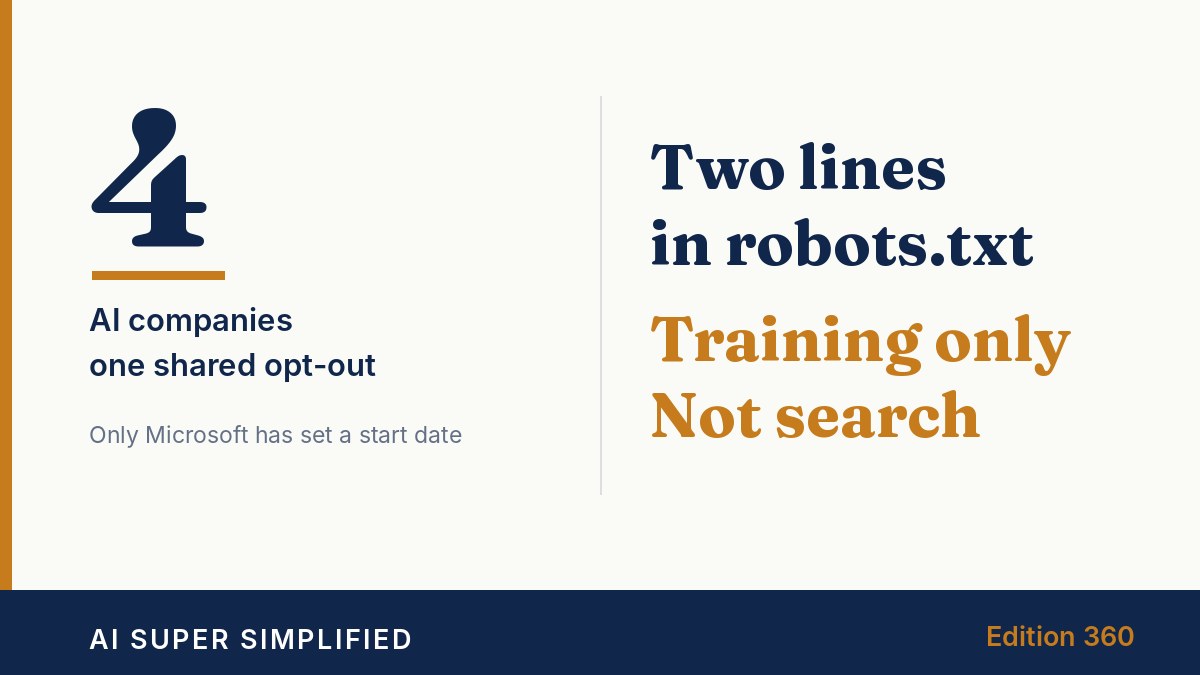
Until now, telling AI companies “don’t train on my website” meant writing a separate rule for each company’s bot, by name, and keeping that list up to date. On October 30, 2026, Google, Microsoft, OpenAI and Anthropic said they will all read one shared instruction instead.
It’s two lines in your site’s robots.txt file, the small public text file that tells automated visitors what you’d like them to do. Add it once, and as each company switches on support, it carries the same “no training” preference to all four.
The catch is timing. Only Microsoft has set a start date: February 1, 2027. Google is aiming for early 2027. OpenAI says “the coming months.” Anthropic, whose Kevin Kelley wrote the proposal, says it has started building support but hasn’t said when it goes live.
The exact lines to add
Here is the whole opt-out. Copy it exactly, including the two underscores at the start of the second word:
User-Agent: __usage_ai-training
Disallow: /
This comes straight from the proposal itself and from Microsoft’s setup guide. “Disallow: /” means your whole site. If you want to keep one folder open to training, say a press kit, the proposal shows adding an Allow line for it:
User-Agent: __usage_ai-training
Disallow: /
Allow: /press-kit/
Three things to know before you paste:
- Give it its own block. Put it at the end of the file with a blank line above it, not squeezed in under another “User-Agent” line.
- A “block everything” rule doesn’t count. The proposal says a “User-Agent: *” line must not be read as covering this new token. Its author put it plainly: a robots.txt file that doesn’t use the new token, “as is true of every one published today, expresses no preference at all.”
- Leave your old rules alone. Google, OpenAI and Anthropic say their existing company-by-company controls, such as Google-Extended, GPTBot and ClaudeBot, keep working. Microsoft is the exception: after March 1, 2027, it will stop reading its older NoArchive and NoCache tags as AI preferences, and once it detects the new lines on a site it ignores those old tags there. If you use NoCache to keep pages out of Copilot answers, check Microsoft’s guide before adding these lines.
What it does, and what it doesn’t
It’s about training only. The proposal borrows its definition from an internet standards working group: AI training means “using an asset to modify the learned parameters of a generative AI model.” In plain English, it’s about teaching future AI models with your pages.
It doesn’t block anyone from visiting. The proposal says the new token “is not a directive for crawling behavior.” Search engines still crawl your site exactly as before.
It doesn’t touch your search rankings. Google says it will treat this opt-out as a block on Google-Extended, its existing AI training control, and Google’s documentation says Google-Extended “does not impact a site’s inclusion in Google Search nor is it used as a ranking signal.” Microsoft says its preferences “do not change eligibility for traditional Bing search results.”
It doesn’t reach back in time. Under the proposal, the preference that applies to a page is the one “in effect when the asset was retrieved.” Anything already collected before you add the lines isn’t covered.
It can’t force anyone. robots.txt has always been an honor system, and bots that ignore it will keep ignoring it. The proposal is a single-author draft, and the standards body’s own page says it “is not endorsed by the IETF and has no formal standing in the IETF standards process.” This isn’t a law. It’s a set of voluntary commitments from four companies.
Who starts listening, and when
- Microsoft: February 1, 2027. It will honor the new preferences “as it crawls,” so your setting takes effect when Bing next visits your pages. Microsoft’s post warns that “publishing a setting is not the same as activating it.”
- Google: its announcement says “We aim to support this new control along with other AI providers in 2027.” Its crawler documentation narrows that to “early 2027.”
- OpenAI: OpenAI’s post says it aims “to implement the signal in the coming months,” as quoted by PPC Land, and calls it a “voluntary effort.” It promised another update with details when it does.
- Anthropic: the draft’s author, Anthropic’s Kevin Kelley, wrote to the standards group that “Anthropic has already started implementing support for this draft.” He also wrote, “It’ll take us some time to add support across our services.” His message gives no live date, though he said it would start becoming usable “over the coming months.”
So as of this week, none of the four has confirmed it’s reading the new lines yet. That’s not a reason to wait. The lines cost nothing, change nothing about search, and will be in place when each company switches on.
How to add it on your platform
First, see what you have now: type your web address followed by /robots.txt into a browser, like yourbusiness.com/robots.txt.
WordPress (your own install): WordPress makes a basic robots.txt automatically. With the free Yoast SEO plugin, go to Yoast SEO → Tools → File editor, click “Create robots.txt file” if asked, paste the two lines at the bottom and save. Yoast notes the File editor won’t appear if your site has file editing turned off; your host can help with that.
Wix: in your dashboard, go to SEO & GEO → Tools and settings → Robots.txt Editor → View File. Paste the lines at the bottom, then click Save Changes and Save. Wix warns that this is an advanced feature and its Customer Care team can’t help with your edits.
Shopify: go to Online Store, open the menu (…) next to your theme and choose Edit code. Click Add a new template, choose robots, then Create template. Paste the two lines at the very bottom, below the existing code, and save. Shopify calls this an “unsupported customization,” says its support team can’t help with it, and warns that “incorrect use of the feature can result in loss of all traffic.” If you’re not comfortable, hand this one to your web person.
Squarespace: Squarespace’s help pages don’t describe a way to add your own lines. Its built-in option, a “Block known artificial intelligence crawlers” checkbox under Settings → Crawlers, blocks a list of named AI bots including GPTBot, ClaudeBot and Google-Extended. The new shared token isn’t on that list yet.
Should you opt out at all?
This is a real choice, not an obvious yes.
Opting out makes sense if your content is the thing you sell: original recipes, guides, courses, photography, research or writing that you don’t want absorbed into a model that never sends anyone back to you.
Staying in makes sense if you mostly want to be found. A plumber’s service pages or a shop’s product listings aren’t the product; the customer is. Microsoft argues that “allowing training can help improve future generative models,” and adds a line worth remembering either way: “Neither choice guarantees inclusion, traffic, or payment.”
Know the Google catch. At Microsoft, training and AI answers are separate switches, so opting out of training leaves your pages eligible to be cited in Copilot answers. Google works differently. It will read this opt-out as a Google-Extended block, and Google’s documentation says Google-Extended also controls whether your pages can be used to ground answers, with links, in its Gemini apps. Google’s post spells out the flip side: “Websites that specifically allow Google-Extended are eligible to appear in responses and receive clicks via grounding in Gemini Apps.” So at Google, saying no to training will also mean saying no to those Gemini citations, unless you add a separate Google-Extended rule, which would let Google train on your pages too. Google’s regular Search results aren’t affected.
| Claim | Figure | Source |
|---|---|---|
| Announced | October 30, 2026, by Google, Microsoft and OpenAI posts and an IETF post from Anthropic’s Kevin Kelley | Google, Bing blogs; IETF mail archive |
| The opt-out lines | User-Agent: __usage_ai-training, then Disallow: / | IETF draft; Bing Blog |
| Standing | Individual draft; “not endorsed by the IETF” | IETF Datatracker |
| Draft author | Kevin Kelley, Anthropic | IETF draft |
| Microsoft start | February 1, 2027, as it crawls | Bing Blog |
| Google start | “2027” (blog); “early 2027” (documentation) | Google Search Central |
| OpenAI start | “in the coming months” | OpenAI, as quoted by PPC Land |
| Anthropic status | “has already started implementing support”; no live date | Kevin Kelley, IETF mailing list |
| “Block everything” rules | User-Agent: * does not count as this opt-out | IETF draft |
| Crawling | “Not a directive for crawling behavior” | IETF draft |
| Search | Google-Extended doesn’t affect Search inclusion or ranking; Bing search eligibility unchanged | Google crawler docs; Bing Blog |
| Gemini catch | Google plans to read the opt-out as a Google-Extended block, which also covers grounding in Gemini apps | Google blog; Google crawler docs |
| Old content | Preference applies to content as of when it was retrieved | IETF draft |
| Microsoft’s old tags | NoArchive and NoCache stop counting after March 1, 2027 | Bing Blog |
Bottom line
For the first time, one short rule can tell four of the biggest AI companies not to train on your website, and none of them has to be named. It covers training only, leaves your search rankings alone, and can’t undo what’s already been collected. Nobody has confirmed they’re reading it yet, and Microsoft is the only one with a date. If your content is your product, add the two lines now so they’re in place when each company switches on. If you mostly want to be found, and Gemini’s answers matter to you, leaving it out is a reasonable call too.