A Pickup Missed Its Sales Goal by 90%. Its Factory Now Builds a Car With No Steering Wheel. | Edition 368
Edition 368 — Tesla ends Cybertruck production in Texas by mid-2027 to build more Cybercabs. What the bet on AI driving means for you.
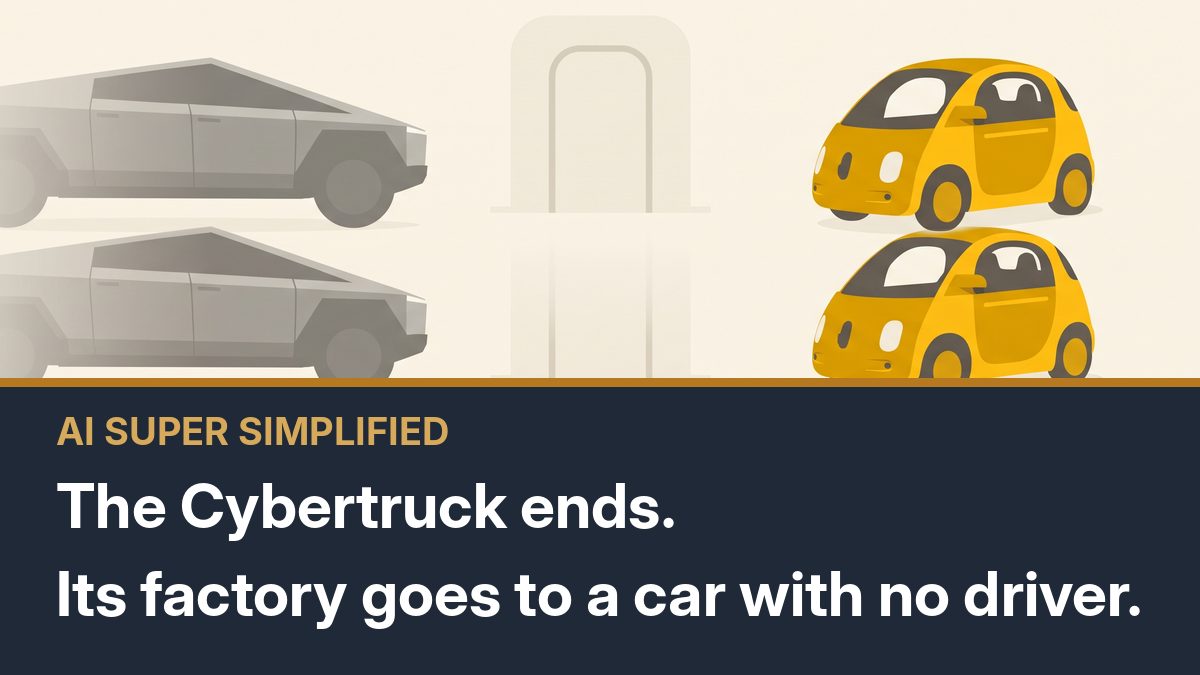
Tesla will stop building the Cybertruck at its Texas factory around the middle of 2027. The reason is the real story: the space is going to the Cybercab, a two-seat car with no steering wheel and no pedals. Its only driver is Tesla’s AI.
“Tesla will be winding down production of the Cybertruck at Gigafactory Texas around the middle of next year to make room for increased Cybercab production,” Elon Musk posted on X in early November.
A truck people drive is making way for a car that drives itself. That’s the clearest sign yet of where Tesla thinks its future is.
What was promised
When Tesla unveiled the Cybertruck in November 2019, the pitch was bold: a stainless-steel pickup starting at $39,900, with a top version good for more than 500 miles on a charge. The event is best remembered for a demo that went wrong. Tesla’s design chief threw a metal ball at the “armor glass” windows, and two of them cracked on stage.
Musk predicted the truck would eventually sell 250,000 a year.
What showed up
Deliveries began in late 2023, years behind schedule. The price and range never matched the pitch:
- Price: the first trucks started near $80,000. The cheapest version Tesla ever offered, launched in February 2026, cost $59,990, and only for 10 days.
- Range: no version came close to 500 miles on its own battery. The longest-range version is EPA-rated at about 335 miles, and the top-end Cyberbeast at about 320.
- Recalls: federal safety regulators list 11 voluntary recalls, including one for a stainless-steel panel that could come loose while driving.
The sales gap
Tesla doesn’t report sales by model, but Kelley Blue Book estimates tell the story. U.S. buyers took 38,965 Cybertrucks in 2024. That fell 48% to 20,237 in 2025, about 8% of Musk’s 250,000-a-year goal. Through the first nine months of 2026, sales fell another 28%, to roughly 11,600.
Part of the slide has been tied to Musk himself: reporting through 2025 linked weaker Tesla demand to backlash over his role in the Trump administration’s DOGE cost-cutting effort. The truck kept a loyal fan base, just not a mass market. Even some of its buyers weren’t ordinary customers. A SpaceX filing showed Musk’s rocket company spent $131 million on Cybertrucks last year.
Where the factory is going: AI driving
This is why the story belongs in an AI newsletter. The Cybercab has no steering wheel and no pedals, so the only driver is software: Tesla’s self-driving AI, trained on driving video collected from Tesla’s fleet.
The Cybercab went into production earlier this year, and Tesla began offering paid rides in a small fleet of them in Austin in September. Texas DMV figures cited by Reuters show about 570 of the more than 1,200 Tesla robotaxis operating in the state are Cybercabs.
Wes Morrill, the Cybertruck’s lead engineer, described the handoff on X: “Cybertruck was an incredible technology development platform and lives on through Cybercab.”
The same AI is already in the Model 3 and Model Y
The Cybercab’s driver isn’t brand-new software. It’s the same AI behind FSD (Supervised), the driver-assist feature Tesla sells for the Model 3 and Model Y. Version 14, Tesla’s current release, steers, changes lanes, handles merges and parks itself, while the driver stays alert and ready to take over. Tesla is already testing version 15 in its robotaxi fleet.
The bigger surprise is what happened to older cars. Version 14 launched first on Tesla’s newer car computer, AI4 (often called HW4). Then, starting in late June, Tesla rolled out “v14 Lite” to cars with the older HW3 computer. Tesla says it “distilled the intelligence” from the new version into the old hardware, bringing over better handling of merges and forks plus new parking and reversing skills. The AI training did the work, so cars several years old moved much closer to new ones without a hardware swap.
Two things to know:
- It’s built on cameras. Tesla’s driving software relies on cameras alone. Tesla stopped fitting radar to new Model 3s and Model Ys in 2021 and has never put lidar in its production cars. Newer cars get sharper cameras and a faster computer.
- Weather is still the hard case, and older cars have a ceiling. Tesla’s own manual warns that FSD may not work as intended when visibility is poor from heavy rain, snow or fog, or when a camera is blocked by dirt, mud, ice or snow. And HW3 cars won’t drive themselves without a supervisor. As Musk put it: “Hardware 3 simply does not have the capability to achieve Unsupervised FSD.”
The catches
- It’s early. Cybercab rides cover Tesla’s service zone in Austin, not the country.
- Regulators are watching. In September, the National Highway Traffic Safety Administration opened an audit into whether Tesla properly certified the Cybercab under federal safety standards, a live question for any car built without manual controls.
- The truck isn’t necessarily gone. Musk didn’t say whether Cybertruck production would move to another factory or end entirely. Texas is the only plant that builds it today, and Musk replied on X that “the Cybertruck fleet will be around for a long time.”
What it means for you
Once the Cybertruck stops, Tesla’s showroom gets thin. The company already ended the Model S and Model X this year to free up its California factory for Optimus humanoid robots, and Musk says the new Roadster won’t enter production until 2028. That leaves the Model 3 and Model Y as the only Tesla passenger cars you can buy and drive yourself.
Tesla is putting its factories behind AI: robots in California, robotaxis in Texas. How fast that pays off depends on how quickly each state lets driverless cars carry the public, and that pace has varied widely so far.
For most people, the practical question isn’t about Tesla. It’s whether owning a car will still beat riding in a few years. You can work that out today with your own numbers.
| Claim | What we found | Source |
|---|---|---|
| Cybertruck output in Texas winds down around mid-2027 | Musk said production at Gigafactory Texas winds down “around the middle of next year” to make room for more Cybercabs | Musk’s post on X, reported by CNBC and Fox Business |
| Original promise | $39,900 starting price; top version rated for 500+ miles; windows cracked at the 2019 unveiling | Tesla’s 2019 unveiling; Engadget |
| 250,000 a year | Musk’s pre-launch prediction for annual sales | CNBC; Fox Business |
| U.S. sales | 38,965 in 2024; 20,237 in 2025 (down 48%) | Cox Automotive / Kelley Blue Book estimates, via CNBC |
| 2026 sales | Down 28% through nine months, to about 11,586 | Kelley Blue Book estimates, via the Associated Press |
| Cheapest version | $59,990, launched February 2026 as a 10-day offer | Musk on X; Entrepreneur; Not a Tesla App |
| Range | Longest-range version EPA-rated at 335 miles; Cyberbeast about 320 | U.S. EPA (fueleconomy.gov) |
| Recalls | 11 voluntary recalls | NHTSA, via CNBC and Fox Business |
| SpaceX purchases | $131 million spent on Cybertrucks last year | SpaceX filing, via CNBC |
| Cybercab rides | Paid rides in Austin since September; about 570 of 1,200+ Tesla robotaxis in Texas are Cybercabs | Texas DMV figures, via Reuters and Fox Business |
| Federal review | NHTSA audit opened in September into Cybercab safety self-certification | Fox Business |
| Model S and X | Production ended in 2026 to make room for Optimus robots | Tesla Q4 2025 earnings call; Motor1 |
| Roadster | Production targeted for 2028 | Musk at the Roadster unveiling, via Benzinga |
| FSD v14 Lite for older cars | Rolled out to HW3 cars from late June 2026, wide release July 21; distills HW4’s v14 into HW3 | Tesla release notes, via Not a Tesla App and Tesla Oracle |
| HW3 limit | “Hardware 3 simply does not have the capability to achieve Unsupervised FSD” | Musk on Tesla’s Q1 2026 earnings call, via Tesla Oracle |
| Cameras only | Radar dropped from Model 3 and Model Y in 2021; no lidar in production cars | Tesla; The Drive; InsideEVs |
| Bad-weather limits | FSD may not work as intended in heavy rain, snow, fog or with blocked cameras | Tesla Model 3 and Model Y owner’s manuals |
| FSD v15 | Early builds running in Tesla’s robotaxi fleet; not yet released to customer cars | Tesla Q2 2026 earnings call, via Not a Tesla App |
A pickup that missed its own sales goal by more than 90% is making room for a car with no controls for a driver at all. Tesla is betting its Texas factory that people would rather be driven than drive. The prompt above tells you what that bet would mean for your own budget.