56% of Workers Say AI Skills Should Earn More. Only 16% Got a Raise for Them. | Edition 380
Edition 380 — Payscale asked 1,000 employees and 500 employers about AI and pay. Pay hasn’t caught up with the skills.
If you’ve spent the past year getting good at AI at work, you may have expected it to show up in your paycheck. For most people, it hasn’t.
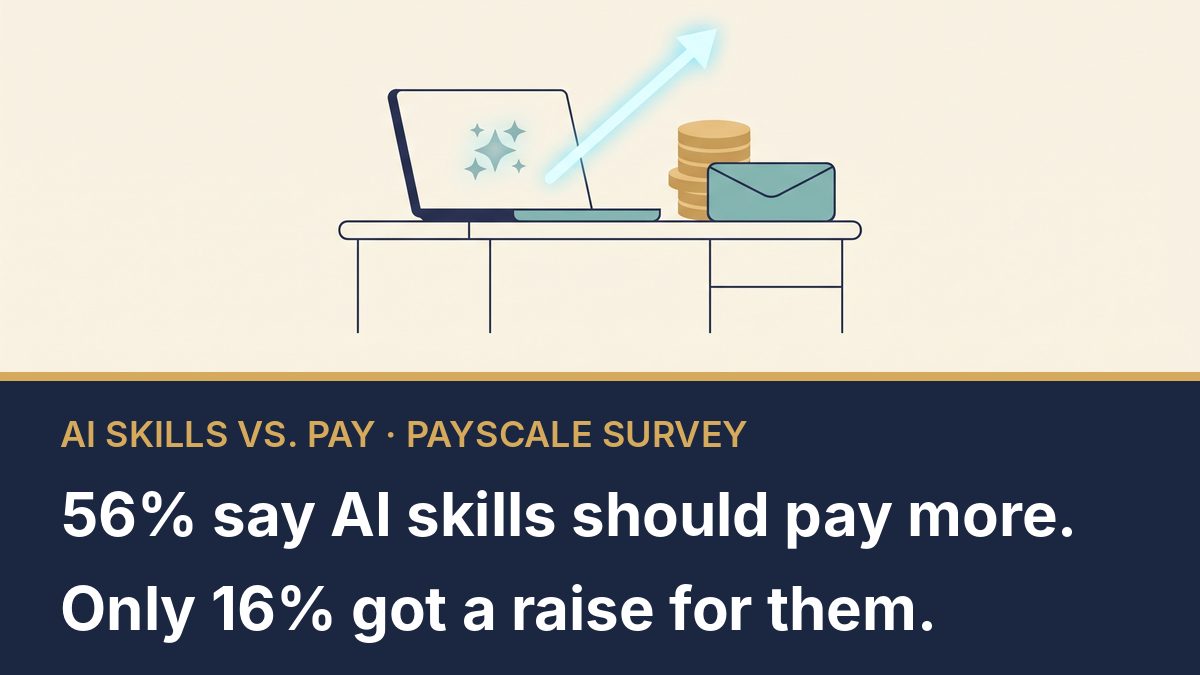
Payscale, the pay-data company, ran two surveys: one of 1,000 full-time employees and one of 500 HR, pay and recruiting professionals, all at organizations with 100 or more employees. 56% of the employees said people who build new AI skills should earn more. Only 16% said their own pay had gone up because of AI-related upskilling. 70% said AI hadn’t changed their pay at all.
What employees said
The pay question split three ways: 56% said yes, workers who build new AI skills should be paid more, 24% said no and 20% weren’t sure. When asked what had actually happened to their own pay, 16% said it went up because of AI-related upskilling, 3% got a bonus, 70% saw no change and 5% said their pay went down because AI partly automated their role.
The time savings are real but modest. 61% of employees said AI saves them less than 10 hours a week, while 43% said it saves them three hours or more.
Where that time goes is the more telling number. Only 19% of employees said they put the time AI saves into more strategic or higher-value work. That 19% counts everyone surveyed, including the 19% who said they don’t use AI in their role at all. Employers expected more: 34% said they primarily expect saved time to go to more strategic work.
And 28% of employees said the time AI saves mostly goes into doing more work in the same hours. That’s close to what employers planned for: 26% of them said they expect exactly that.
What employers said
On the employer side, the jobs themselves are moving faster than the pay systems built around them:
- 61% say job descriptions are being rewritten because of AI.
- 48% say current market pay benchmarks no longer reflect the skills many roles now need.
- 49% say their salary structures are struggling to keep pace.
- 40% say they’re struggling to find candidates with enough AI fluency.
Employers also plan to train more than employees can see. 74% plan to invest in AI-related upskilling in the next 12 months, but only 29% of employees say they see clear investment in their own development.
One finding points to where this is heading: 23% of employers said they had moved from paying a premium for AI skills to treating AI fluency as a basic requirement of the job. For some employers, AI skills are already expected rather than rewarded.
“AI is changing the value employees bring to their roles, but compensation practices haven’t kept pace,” said Ruth Thomas, chief compensation strategist at Payscale.
Read it with care
Payscale sells compensation data and software, so a finding that pay practices need updating is good for its business. The surveys were run online through the research firm Dynata in August, and every answer is self-reported. The employee and employer numbers come from two different groups of people, so they describe two points of view, not one company’s books. Payscale’s published methodology doesn’t say which country the respondents were in.
What to do with it
If you use AI to do your job better, don’t wait for the pay system to notice on its own:
- Keep a simple log. For a month, write down what you used AI for and roughly how much time it saved.
- Write down where the time went. More output, faster turnaround or a project nobody had time for. That’s the part a manager can pay for.
- Check your job description. If AI work is now part of your role but isn’t in the description, that’s a fair thing to raise at your next review.
If you manage people, decide on purpose what saved time is for. If you want it to go to higher-value work, say so, and decide how you’ll recognize it.
The prompt below interviews you one question at a time and turns your answers into a short, honest case for your next pay conversation.
| Claim | What we found | Source |
|---|---|---|
| 56% say AI skills should earn more | Employees; 24% said no, 20% unsure | Payscale, AI Workforce Impact Report (report page) |
| 16% got a pay increase from AI upskilling | Employees; 70% no change, 3% bonus, 5% pay decreased | Payscale, AI Workforce Impact Report (report page) |
| 61% save under 10 hours a week | Employees; 43% save three hours or more | Payscale, AI Workforce Impact Report (press release) |
| 19% put saved time into strategic work | All employees, including the 19% who don’t use AI; 34% of employers expected strategic work | Payscale, AI Workforce Impact Report (report page) |
| 61% rewriting job descriptions | Employers | Payscale, AI Workforce Impact Report (press release) |
| 48% / 49% | Employers: benchmarks out of date / salary structures struggling to keep pace | Payscale, AI Workforce Impact Report (press release) |
| 74% vs 29% | Employers planning AI upskilling vs employees who see clear investment | Payscale, AI Workforce Impact Report (press release) |
| 23% now treat AI fluency as required | Employers that moved from paying a premium | Payscale, AI Workforce Impact Report (report page) |
| Two surveys, August, via Dynata | 500 employer respondents and 1,000 employees at organizations with 100+ staff; country not stated | Payscale, AI Workforce Impact Report (report page) |
Has AI shown up in your pay?
Hit reply and tell me: did getting good at AI earn you a raise, a bigger job, or just more work? I read every response.