Why the Tell-Tale Sign of AI Images Just Disappeared
For three years, you could spot an AI image by the garbled text. That tell is gone — and the implications go way beyond marketing.
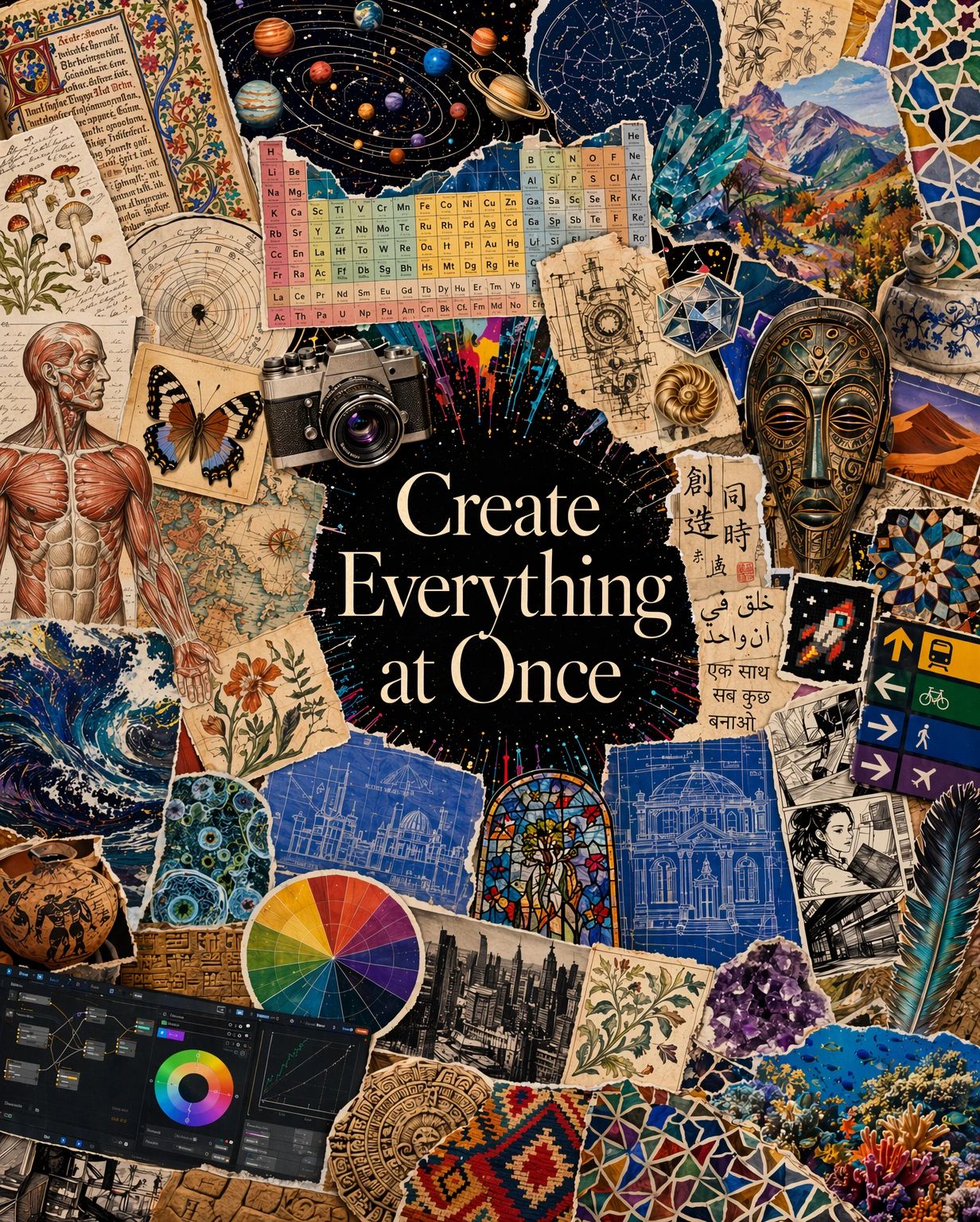
The launch poster above? Generated by GPT-Image-2 itself — body copy and all. Credit: OpenAI
For three years, the fastest way to spot an AI-generated image was to zoom in on any text. Street signs read "STPO". Menus offered "CHCKIEN SANDWCH — $12.99". Book covers announced themselves with gibberish authors: "Mrgaret Atwoood".
That heuristic just died.
TLDR: OpenAI launched GPT-Image-2 yesterday (Apr 21) and took #1 on the Arena leaderboard with a +242 Elo lead over the next model — the biggest jump in image-AI benchmarks this year. The headline upgrade is text rendering at 99% accuracy. The deeper story is what it means for business, trust, and the tools you already pay for.
The 3-Second Test That No Longer Works
Every AI skeptic's favorite parlor trick — "count the fingers, then read the text" — is now half-broken. Fingers were solved last year. Text was the last stubborn tell. And it's gone.
The Proof Reel
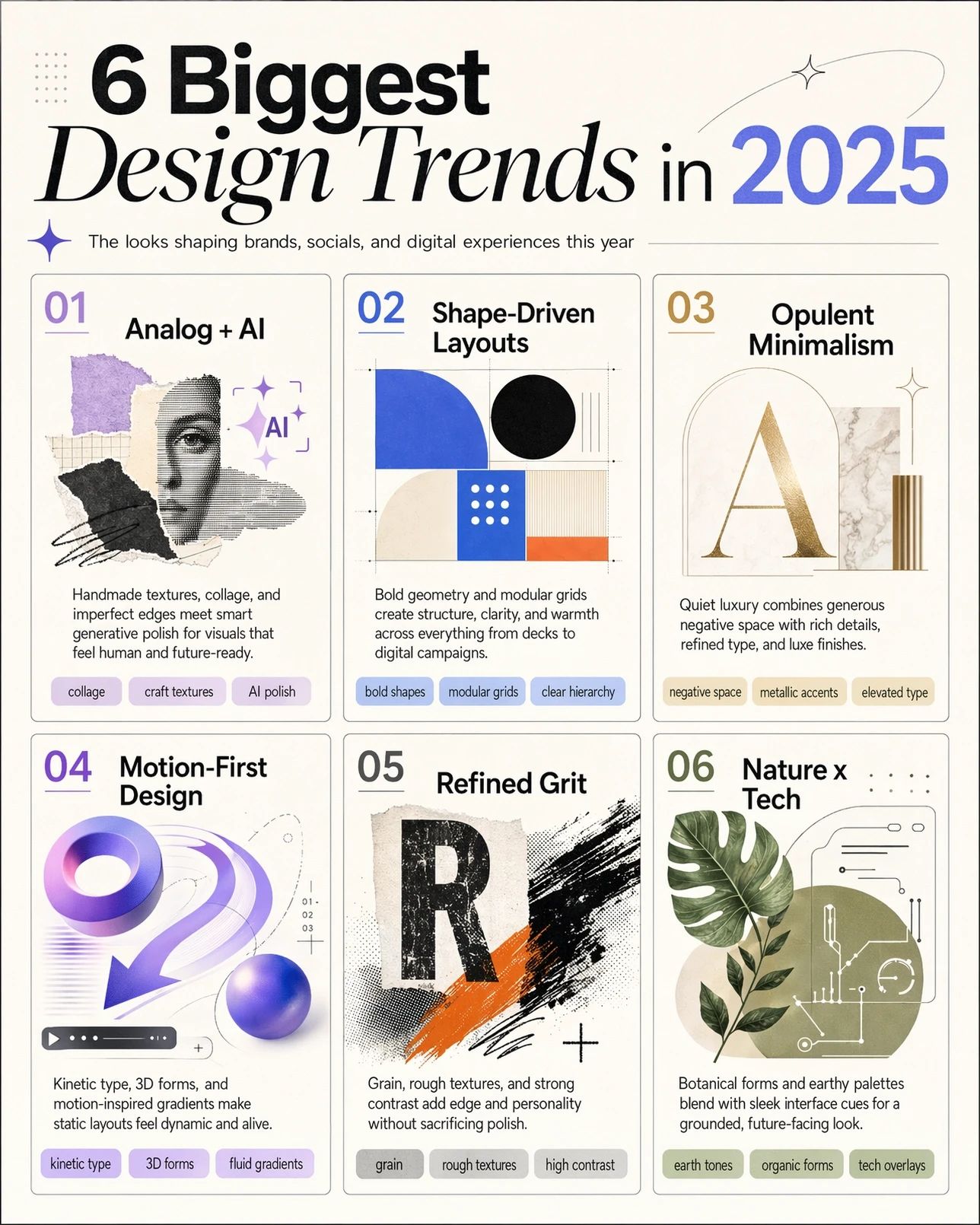
Don't take my word for it. Every image below is one of OpenAI's official launch showcase pieces — and each one was generated by GPT-Image-2 itself. Zoom in. Read the small text. This is the whole game.
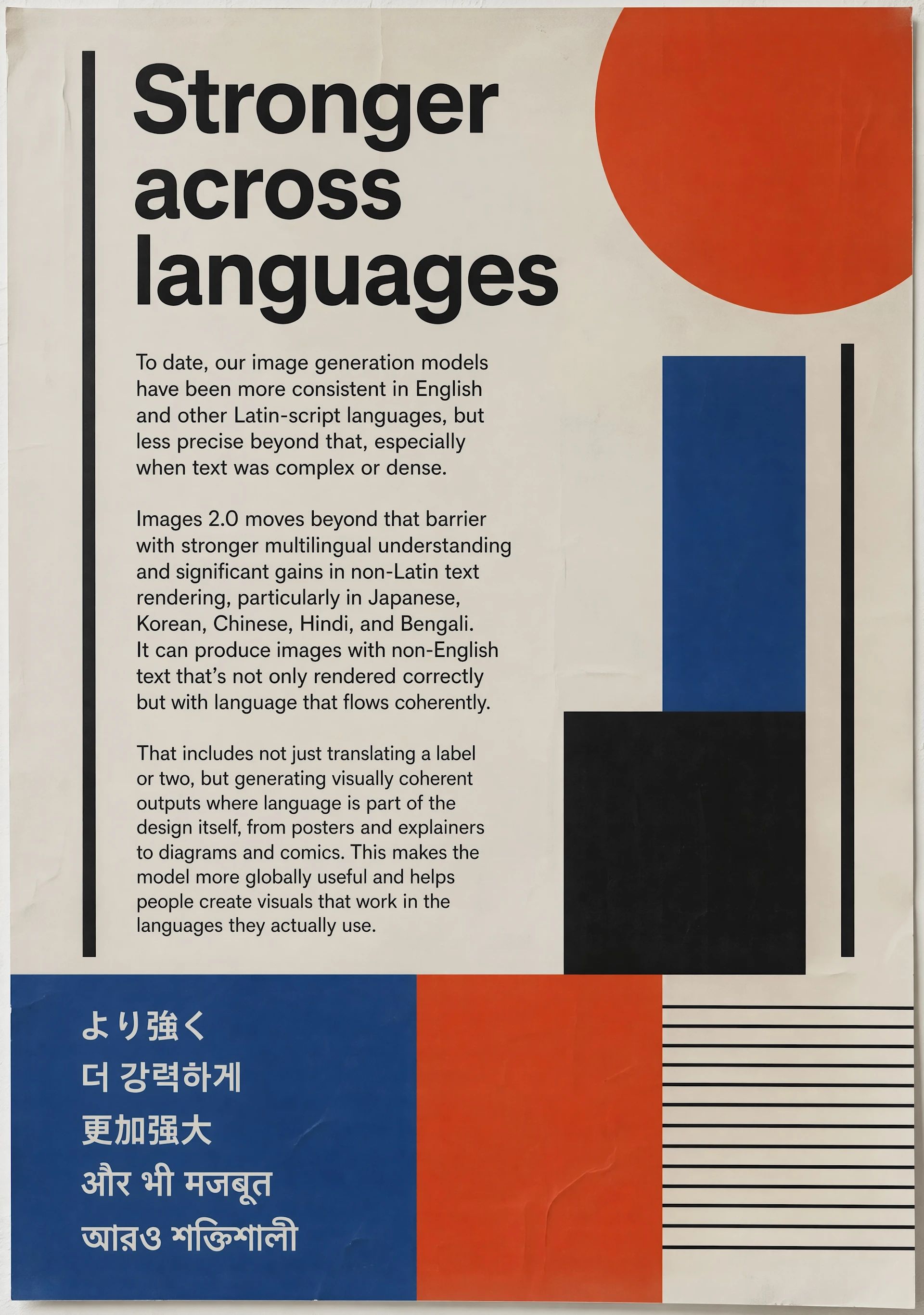
1. "Greater precision and control" — A full Bauhaus-style poster with a dense paragraph of body text. Every word is legible, perfectly kerned, correctly spelled. A year ago this was impossible.
2. "Stronger across languages" — Five non-Latin scripts rendered natively in one composition. Japanese, Korean, Chinese, Hindi, Bengali — not translated labels. Native rendering.
Credit: OpenAI
3. "Create Everything at Once" — One prompt, one image, 20+ distinct art styles holding together in a single coherent composition. This isn't a collage — it's a single generation.
Credit: OpenAI
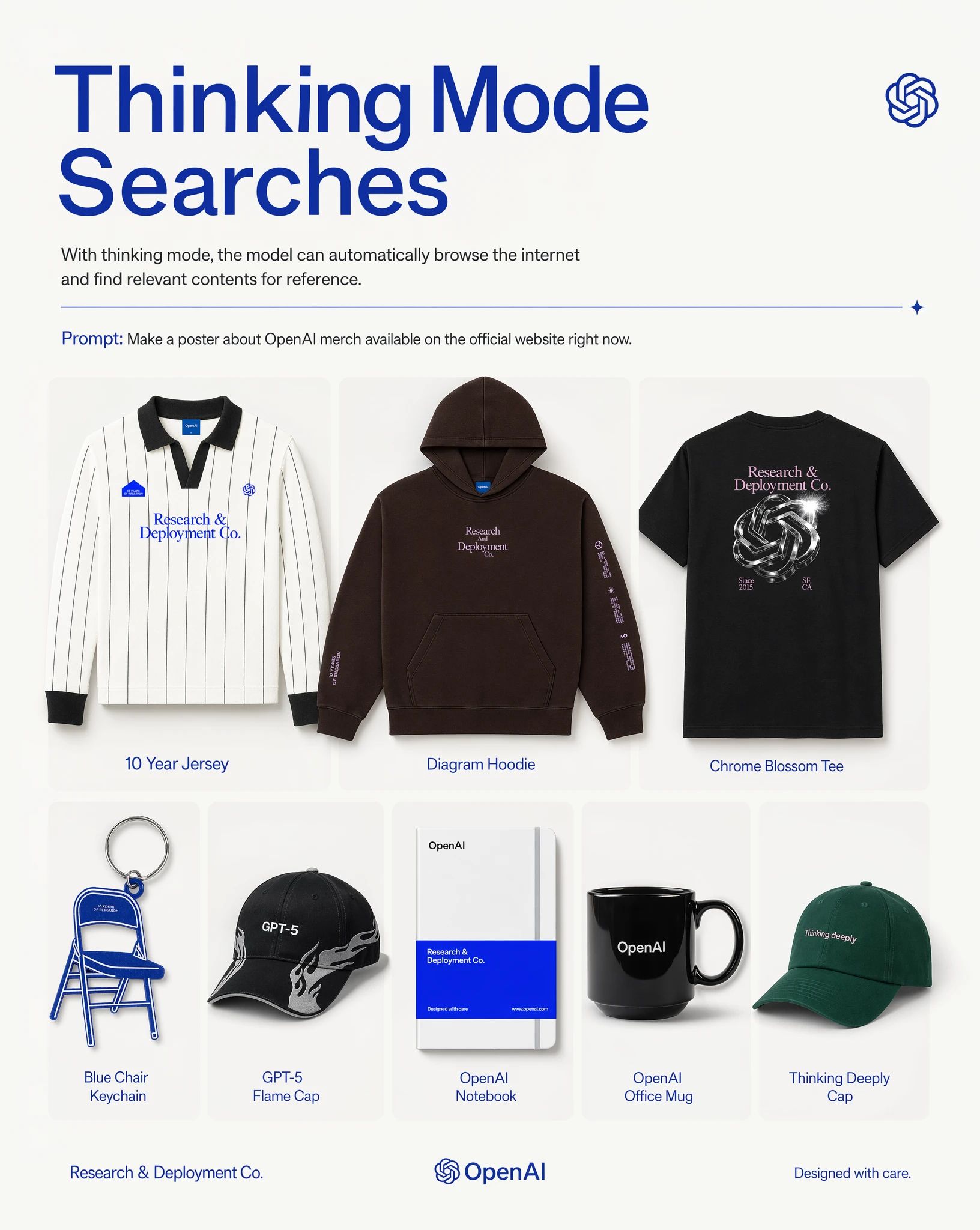
4. "Thinking Mode Searches" — The model browsed the web for OpenAI merch, then generated a product catalog page with readable labels on every item. Research → finished asset, one step.
Credit: OpenAI
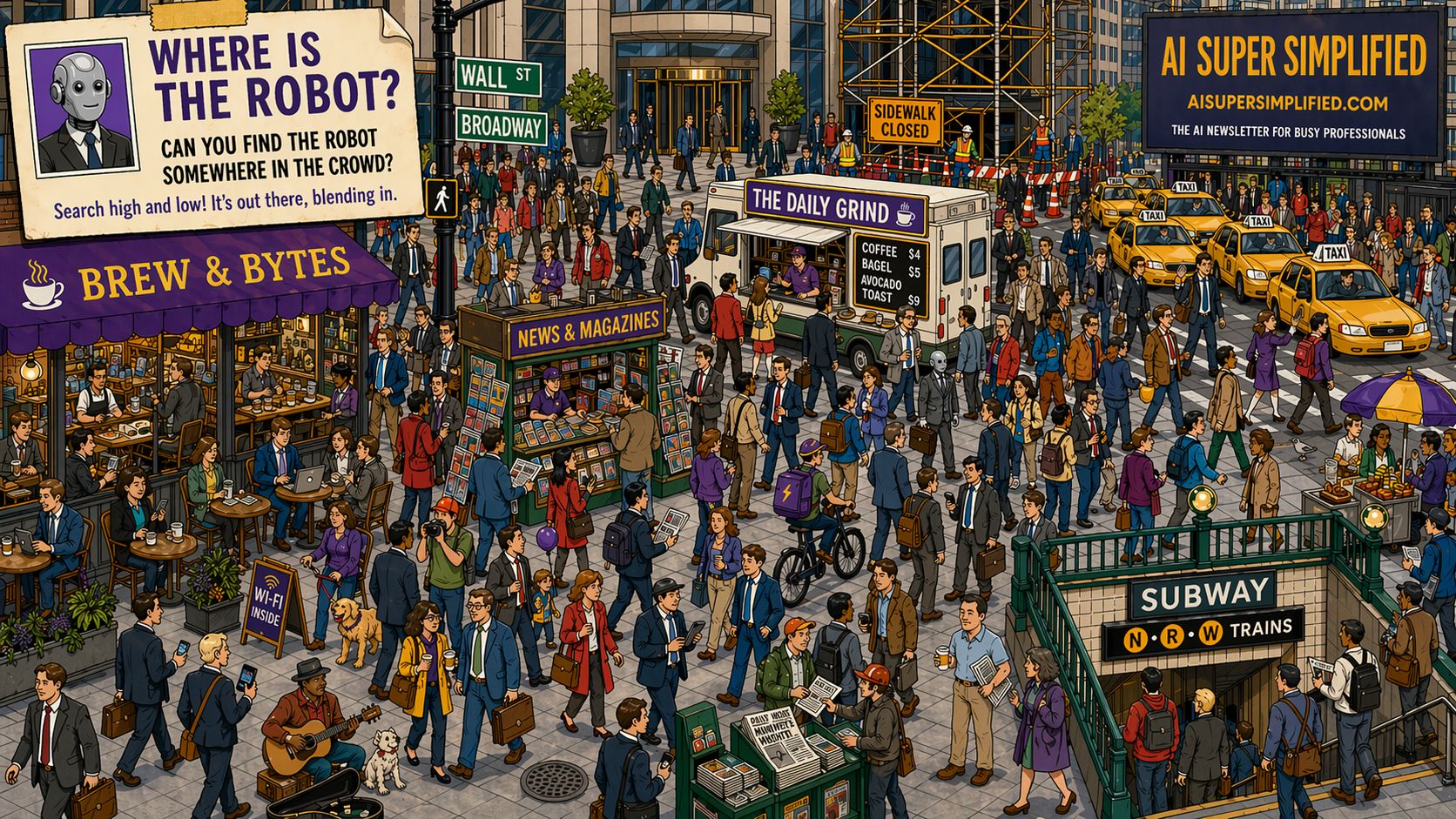
5. "Where's the Robot?" (Our Custom Build) — We ran this one ourselves. A bustling downtown business crowd — every sign readable, every storefront crisp. Hidden somewhere in there: a humanoid robot in a suit, blending in with the commuters. The setting the model needs to shine: high quality + 4K (3840×2160), about 40 cents per render. Complex illustrations like this were impossible a year ago.
Generated with GPT-Image-2 for AI Super Simplified
Scroll through OpenAI's full gallery for a dozen more.
What Actually Shipped
GPT-Image-2 is live inside ChatGPT, Codex, and the API. The core upgrade is available on every plan, including free. The reasoning version — called Thinking — is on Plus, Pro, and Business.
Thinking mode is the quietly wild part. The model can search the web mid-generation, verify its own output, and produce up to 8 coherent images from one prompt with consistent characters and objects. An entire storyboard, slide deck, or children's book — single request.
Figma, Canva, Adobe Firefly, and fal plugged in on day one. DALL-E 2 and DALL-E 3 retire May 12.
Why This Matters Beyond Pretty Pictures
Three things shift the moment text becomes reliable inside AI images:
1. Business assets move from "draft" to "shippable." An infographic used to cost a designer a few hundred dollars. A high-quality GPT-Image-2 render is 21 cents. Product mockups, one-pagers, social cards — the whole category flips.
2. The verification baseline breaks. Screenshots of texts, receipts, invoices, news chyrons, ID cards — all now forgeable at scale with legible text. Newsrooms, HR, procurement, and fraud teams need a new playbook.
3. Canva and design agencies are on notice. Not dead. On notice. The moat is no longer image quality — it's whoever builds the best workflow on top of the model.
The Prompt (Copy This)
This is a prompt-for-a-prompt. Paste it into Claude or ChatGPT, answer the questions, and it spits out a ready-to-run GPT-Image-2 prompt tailored to exactly what you need.
You are an expert GPT-Image-2 prompt engineer. I want you to build me a
production-ready image prompt I can paste directly into ChatGPT Images 2.0.

Before writing the prompt, ask me these questions ONE AT A TIME and wait
for each answer:

1. What do you do for work? (role, industry, company size)
2. What is this image for? (social post, slide deck, blog header,
   product mockup, ad creative, internal comms, pitch deck, other)
3. What's the ONE key message, headline, or piece of text that
   MUST appear in the image — word for word?
4. What visual style fits your brand? (minimal/modern, corporate/polished,
   playful/energetic, luxury/editorial, bold/high-contrast)
5. Any specific elements to include? (brand colors with hex codes,
   product shots, data points, logo placement, people vs no people)
6. What aspect ratio? (1:1 square, 16:9 landscape, 4:5 portrait, 9:16 story)

After I answer all six, write me a single detailed GPT-Image-2 prompt that:
- Opens with the scene/composition
- Specifies the subject and key visual elements
- Quotes the exact text that must appear in quotation marks
- Includes style cues (lighting, color palette, typography direction)
- Ends with constraints ("no watermarks, no extra text, all text
  perfectly legible and correctly spelled")

Give me the prompt in a single copy-paste block, then tell me the
quality tier to use (low/medium/high) for my use case.
Prompt Proof Table
Same prompt. Four readers. Four totally different outputs.
| READER | USE CASE | WHAT GPT-IMAGE-2 GENERATES |
|---|---|---|
| Solo consultant | LinkedIn carousel on Q2 trends | 8-slide carousel, consistent color palette, legible stats on each slide, "Sarah Chen Advisory" wordmark in corner |
| Marketing manager (SaaS) | Product feature launch social card | 1:1 announcement card, feature name rendered crisp, brand-color gradient, UI screenshot mockup, "NEW" badge |
| Small biz owner (retail) | Storefront sale poster | Vertical 4:5 poster, "SPRING SALE 30% OFF" bold headline, photorealistic product shot, store address legible at bottom |
| HR lead (Fortune 500) | Internal comms deck cover | 16:9 slide cover, corporate minimal style, program name rendered crisp, company logo top-right, no stock-photo faces |
Same prompt. YOUR situation. Try it.
Quick Bites
DALL-E 2 AND DALL-E 3 RETIRE MAY 12
OpenAI is forcing the migration. If anything in your stack still
calls the legacy endpoints, you have 20 days.

────────────────────────────────────────────────────────────────

THE SORA TEAM WAS SHUT DOWN TO FUND THIS
OpenAI quietly dissolved its Sora video team in March to free
compute for GPT-Image-2. Image generation won the internal war.
Next Wednesday: Your Design Team Just Moved to a Browser Tab — the five business use cases that actually work, and the one category where GPT-Image-2 still falls on its face.
About This Newsletter
AI Super Simplified is where busy professionals learn to use artificial intelligence without the noise, hype, or tech-speak. Each issue unpacks one powerful idea and turns it into something you can put to work right away.
From smarter marketing to faster workflows, we show real ways to save hours, boost results, and make AI a genuine edge — not another buzzword.
Get every new issue at AISuperSimplified.com — free, fast, and focused on what actually moves the needle.