Why the First Answer Your AI Gives You Is Almost Never Its Best
Most professionals ask once and move on. The ones getting remarkable results treat it like an interview — here's the technique, and a prompt that builds you a better one.
You asked your AI to write the proposal. It wrote a proposal. You changed the company name and sent it.
That's not using AI. That's outsourcing your thinking and forgetting to check.
There's a documented psychological pattern behind this — and once you know it, you can't unsee it in your own workflow.
Why your brain accepts the first answer
There's a documented psychological pattern called automation bias — the tendency to accept confident outputs from automated systems without scrutinizing them. It's been studied in aviation, medicine, and now AI.
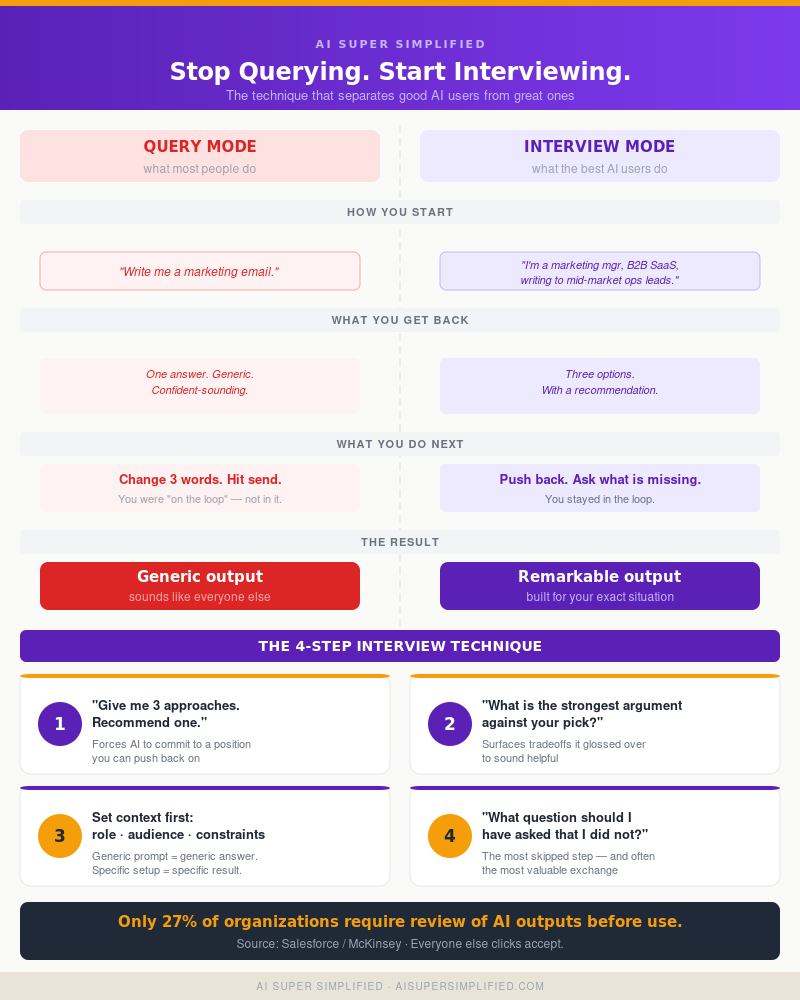
The business version is already running at scale: only 27% of organizations require employees to review AI-generated content before it's used. Everyone else clicks accept.
Here's the part that should stop you cold: research from the International AI Safety Report 2026 found that in studies of AI-assisted writing, using a chatbot didn't just shift the text produced — it shifted the author's own opinions toward the model's suggestions. You thought you were the editor. You were the subject.
The Wall Street Journal reported this week on the same problem in high-stakes decision-making: the shift from 'human in the loop' (decision-maker) to 'human on the loop' (passive monitor). That shift is happening at your desk, silently, every time you accept the first draft.
The interview technique
The people getting dramatically better AI results aren't using smarter tools. They're using a different behavior: they treat every session like an interview, not a search query.
Never accept the first answer. Say: Give me three approaches to this. Then recommend one and explain why. You just forced the AI to show its work and commit to a position you can push back on.
Push back on the recommendation. Ask: What's the strongest argument against this approach? What are you not telling me? This is where the real value hides — the tradeoffs the AI glossed over to sound helpful.
Front-load your context. Tell it your role, your audience, and your constraints before it writes a word. A generic prompt gets a generic answer. A specific setup gets a specific result.
Ask what you didn't ask. End with: What question should I have asked that I didn't? Most people never try this. It's often the most valuable exchange in the session.
This takes about 90 extra seconds. The output difference is not 90 seconds worth of better.
The highest-leverage skill in AI right now
Everything above becomes faster once you know how to write a good prompt from the start.
We built a prompt that does this for you — by interviewing you about your role, your task, your format needs, and your constraints. It then builds a fully custom, interview-first prompt you can use immediately.
What makes this one different: every prompt it builds ends with a Decision Scorecard — a visual block showing confidence level, risk rating, time horizon, and the assumptions the AI made to get there. Plus a Challenge This section that argues against its own recommendation. You've never seen an AI produce output like this.
| Reader | Their Answers | Custom Prompt They Got |
|---|---|---|
| Marketing Manager — writes campaign briefs | Writing · Team · Structured · Professional | You are a senior marketing strategist. Before writing a single word, ask me ONE AT A TIME: (1) Product and its single biggest benefit? (2) Target audience in one sentence? (3) One action you want them to take? (4) Budget tier? Then deliver: positioning statement · three creative directions · channel recommendation with rationale. End with CHALLENGE THIS and a SCORECARD. |
| Operations Lead — improving a process | Strategy · Team · Structured · No constraints | You are a business process consultant. Before recommending improvements, ask me ONE AT A TIME: (1) What process is breaking down? (2) How many people are involved and what tools do they use? (3) Is the goal speed, accuracy, or cost? (4) What has already been tried? Then give three quick-win changes and one structural fix, with effort and impact rated for each. End with CHALLENGE THIS and a SCORECARD. |
| Small Business Owner — writes customer emails | Writing · Customers · Conversational · Warm tone | You are a warm, direct copywriter. Ask me ONE AT A TIME: (1) Why are you reaching out? (2) Is this customer new, loyal, or lapsed? (3) What do you want them to do after reading? (4) Is there a deadline or offer? Write an email under 150 words with a subject line, human opening, core message, and clear call to action. End with CHALLENGE THIS and SCORECARD. |
| HR Manager — writes job descriptions | Writing · External · Structured · Professional | You are a talent acquisition specialist. Ask me ONE AT A TIME: (1) Role level — entry, mid, senior, or leadership? (2) Three must-haves that are genuinely non-negotiable? (3) What makes this role worth choosing? (4) What do candidates often assume that is wrong? Write: compelling opening paragraph · must-have list · nice-to-have list · culture close. End with CHALLENGE THIS and SCORECARD. |
The first answer is what AI gives everyone.
The best answer is what happens when you stop accepting it.