Why AI Can Ace the Bar Exam but Can't Read a Clock
The smartest tool you own has a toddler-sized blind spot — and knowing where it lives is the difference between using AI and getting burned by it.
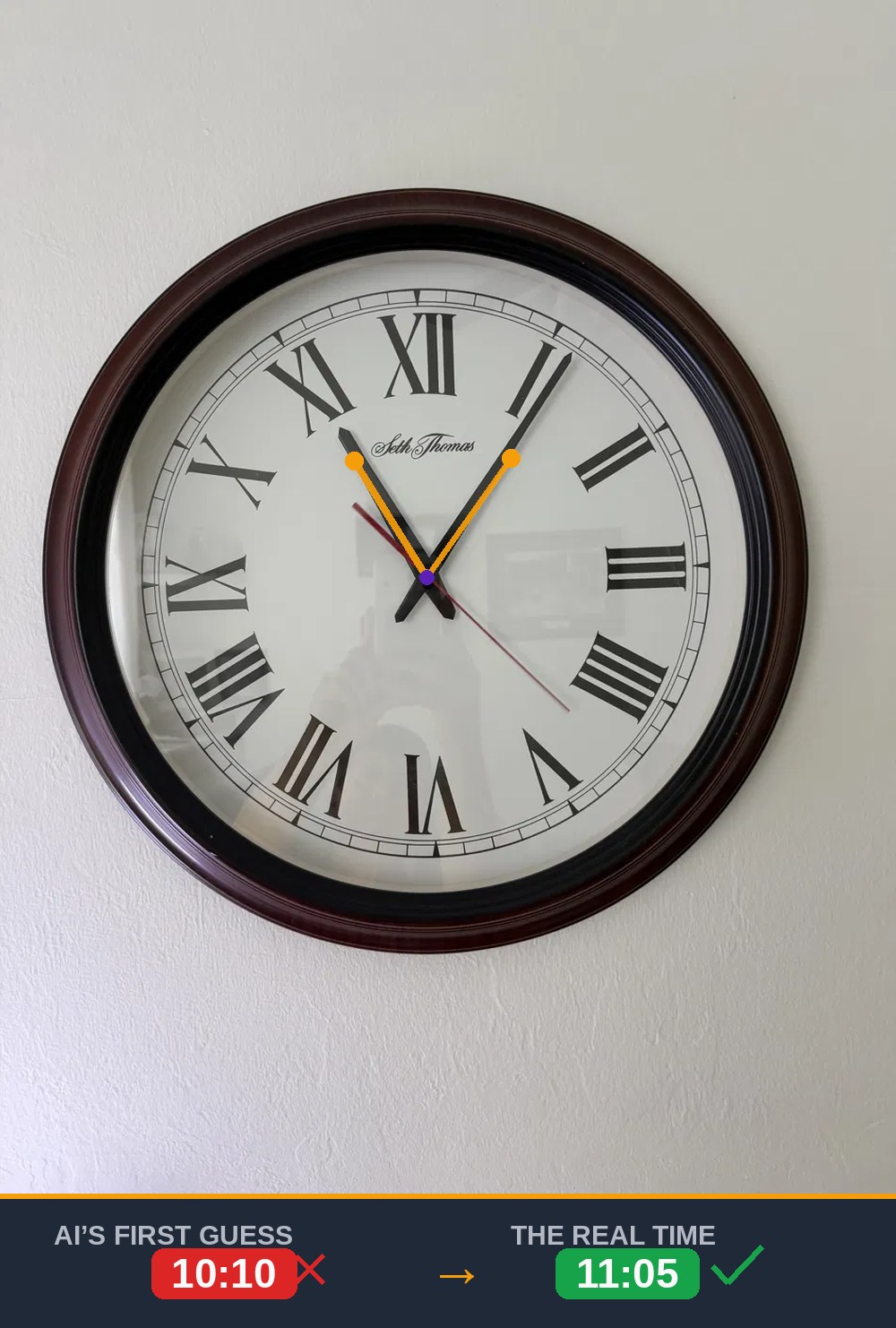
We handed our own AI a photo of an ordinary wall clock and asked one question: what time is it?
The answer came back instant and confident: 10:10.
It wasn't. The hour hand sits on the XI, the minute hand on the I. It's 11:05. The model never read the clock — it reached for the time nearly every clock in its training was set to (10:10, the “smile” pose watchmakers have used in ads since the 1950s) and pattern-matched. Only when forced to measure the hands one at a time did it land on the right answer.
That should make you sit up: the same model passes the bar exam, drafts diagnoses doctors agree with, and writes production code. It does the hard thing and flunks the easy thing — in the same breath.
Here's the kicker, and we clocked it: getting from 10:10 to 11:05 took our AI five rounds of pixel-by-pixel measurement and roughly 30,000 tokens of reasoning — and its first answer was still wrong. A six-year-old reads the same dial in about a second, for free. That gap, in one number, is the jagged frontier.
What it cost to read one clock | ||
|
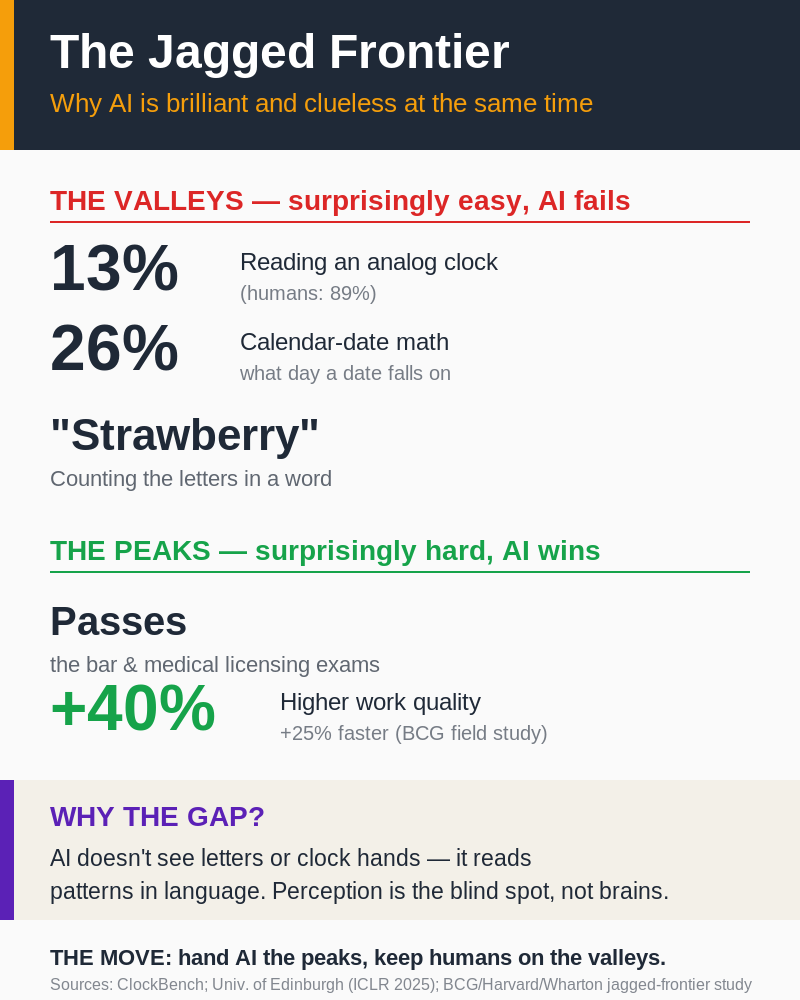
This isn't a quirk of our wall clock. On the ClockBench benchmark, humans read analog clocks with 89% accuracy; the best AI model managed 13%. A University of Edinburgh study presented at a 2025 research conference found the leading models — GPT-4o, Gemini, Claude — placed the hands correctly less than a quarter of the time, and botched calendar-date math once every five tries. The tell: that test deliberately used oddball clock faces, so the models couldn't lean on the 10:10 “smile” crutch the way ours just did.
The mountain range, not the ladder
We tend to imagine AI climbing a ladder: a little smarter every month, rung by rung, until it passes us. That's the wrong picture.
Wharton professor Ethan Mollick and a team from Harvard, MIT, and BCG gave it a better one: the jagged frontier. AI capability isn't a smooth line — it's a mountain range. Towering, superhuman peaks sit right next to valleys where the model fumbles things a six-year-old handles. Two tasks that look equally hard to you can land on opposite sides of that ridge. The difficulty you perceive tells you almost nothing about whether AI will nail it or face-plant.
The jagged frontier of AI Tasks that feel equally hard to you land on opposite sides of the ridge |
| what feels "equally hard" to a humanbar examwrite codediagnoseread a clockcount letterscalendar math● peaks: AI is superhuman● valleys: a six-year-old wins |
Why the easy stuff breaks
The failures aren't random, and they're weirdly reassuring once you understand them.
Take the clock. When one writer fed clock images to Claude and watched it fail, she tried something clever: she described where the hands were pointing in words. The model calculated the time instantly, no problem. The reasoning was never broken — the breakdown happened upstream, in how the model sees an image and turns angles into something it can think about. Spatial perception, not intelligence.
The famous “how many R's in strawberry” stumble is the same story from a different angle. The model doesn't read letters — it reads chunks of text called tokens, so “counting the letters” is asking it to see something it was never looking at. Not stupidity. A blind spot with a known cause.
Our clock gave away one more tell. The model didn't compute 10:10 from the hands — it remembered it. Nearly every clock in its training data is photographed at 10:10 (the “smile” the ad industry has used since the 1950s), so it reached for the most common answer instead of reading the dial in front of it. Want to watch it happen live? Photograph any clock that isn't set to 10:10 and ask your AI the time — then watch it hesitate.
That's the reframe: these aren't signs AI is overhyped. They're a map. Every documented valley is a place you now know to keep a human in the loop — and every peak is a place you can lean in hard.
Where it's genuinely superhuman
And the peaks are real. In BCG's large field experiment, consultants using AI on tasks inside the frontier finished 12% more tasks, 25% faster, with 40% higher quality. Developers using AI coding assistants have posted productivity jumps north of 50%. On knowledge work that lives on the peaks — drafting, summarizing, structured analysis, first-pass code, brainstorming, translation — the gap runs the other way: the machine laps you.
The trap isn't that AI is weak. It's that the peaks are so impressive you start trusting the valleys too.
How to actually use this
You don't need to memorize a list of what AI can and can't do — the frontier shifts every few months anyway. You need a habit: before you delegate a task, ask which side of the ridge it's on.
A quick rule of thumb: AI is strong when the task is about language, patterns, and synthesis (turn this into that, find the through-line, draft a version). It gets shaky when the task needs precise perception, exact counting, real-world spatial sense, or live-updating truth (read this gauge, count these exactly, what's true right now). When you're not sure, give it the task and a way to show its work — then spot-check the valleys.
To make that concrete for your job, we built an interview-style prompt. It asks about your actual role and the tasks you do each week, then hands you back a personalized map: green-light work to delegate now, red-light work to keep human, and the yellow-light tasks worth testing with a safety net.
| Your job | Hand to AI now | Keep human | The surprise |
|---|---|---|---|
| Marketing manager | First-draft copy, A/B variants, repurposing one post into ten | Reading live campaign dashboards off a screenshot | It writes the ad but miscounts the metrics in the chart |
| Paralegal | Summarizing case law, drafting clauses, spotting inconsistencies | Calculating filing deadlines from a date | Brilliant on the brief, shaky on 'what day is 45 days out' |
| Nurse / clinician | Drafting patient-education notes, summarizing research | Reading an analog wall clock or a gauge from a photo | Explains the condition expertly, can't reliably read the dial |
| Software developer | First-pass code, refactors, test scaffolding, docs | Counting exact characters / column alignment by eye | Ships the function, then miscounts the brackets it just wrote |
The next time AI dazzles you, remember the clock. The most useful thing you can know about a genius is exactly where it's blind — because that's the spot where you are still the expert.