Why Google Just Renamed the AI Tool 30 Million People Use | Edition 279
Edition 279 — NotebookLM is now Gemini Notebook. What's free, what's private, and the nine things it can build from your documents.
On July 16, Google renamed NotebookLM to Gemini Notebook. Google's own words: "It's the same standalone product, now doing more across the Google ecosystem." Your old links keep working — automatic redirects handle existing shared notebooks. The stat buried in the same announcement is the real story: more than 30 million people and over 600,000 organizations use it. If you have a pile of documents and a stack of questions, this is the Google tool built for you.
What it actually does
Most AI chatbots answer from everything they were trained on. Gemini Notebook answers only from what you give it. Upload your sources — PDFs, Word docs, CSVs, PowerPoint, audio files, web pages, even public YouTube videos with captions — and every answer is grounded in those sources with clear in-line citations. Click one and it jumps to the exact passage. Google says it plainly: "Gemini Notebook can make mistakes." The citations exist so you can check. That checkability is the feature.
What the free tier buys you
Load your vendor contracts into one notebook and ask which ones auto-renew this quarter — every answer footnoted to the clause. Or build an onboarding notebook from your handbook and process docs, then generate an Audio Overview: two AI hosts discussing your material as a podcast, in formats from Deep Dive to The Debate, in more than 80 languages. And audio is one option of nine: the same Studio panel builds video overviews, slide decks, infographics, data tables, mind maps, flashcards, quizzes, and reports from the same sources. Free accounts get 3 Audio Overviews and 3 Video Overviews a day, plus 10 each of reports, flashcards, quizzes, and mind maps. Two catches: websites import text only, and paywalled pages don't work.
The privacy line, read carefully
On a consumer account, Google says content in Gemini Notebook "will not be used to directly train our foundational AI models, unless you choose to provide feedback." Workspace business accounts get the stronger promise: uploads, queries, and responses are not reviewed by human reviewers and are not used to train AI models. Neither statement means Google never sees your data.
What the rename actually adds
Notebooks now sync with the Gemini app, and Search AI Mode integration is announced as coming. Bigger: every notebook gets a "secure cloud computer" that writes and runs code to analyze data in your sources — on Ultra and qualifying Workspace plans today, Pro over the coming weeks. It is not on the free tier. Under the hood, everything runs on Google's latest Gemini models.
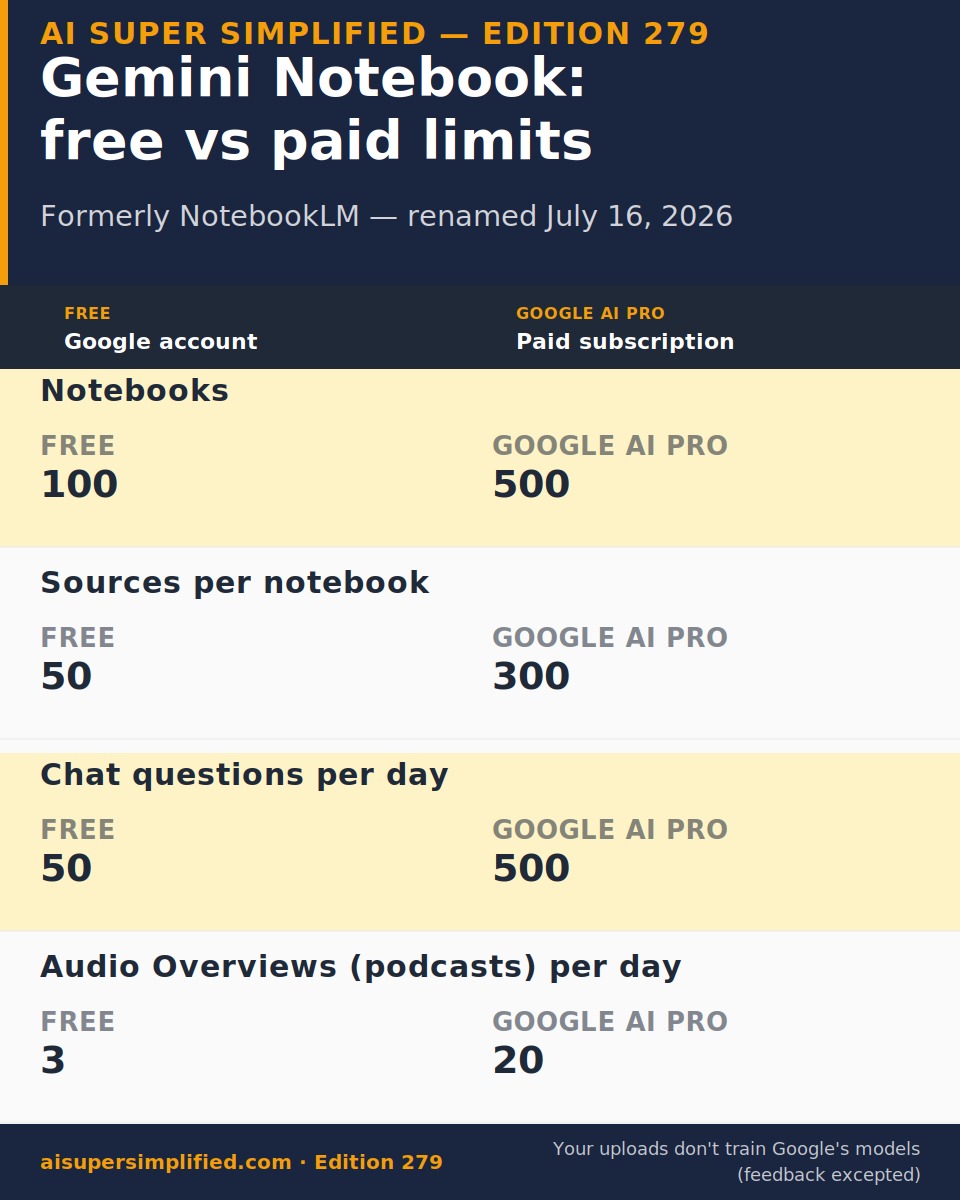
| Limit | Free | Google AI Pro |
|---|---|---|
| Notebooks | 100 | 500 |
| Sources per notebook | 50 | 300 |
| Words per source | 500,000 (200MB) | 500,000 (200MB) |
| Chats per day | 50 | 500 |
| Audio Overviews per day | 3 | 20 |
What this means for you
Start free, start specific. One notebook, one real pile — contracts, the handbook, this quarter's meeting notes. The free limits are generous enough to prove the value.
Trust the citation, not the summary. The product's honest pitch is not "never wrong" — it's "always checkable." Click through to the passage before you act on an answer.
This already changes lives. In Edition 147 we told the story of a son who loaded more than 1,600 pages of his mother's medical records into this same product and helped catch a misdiagnosis. Same tool, new name, bigger reach.
The tool changed its name. The advice didn't: give the AI your documents, and make it show you where every answer came from.