One Company Now Owns Grok, X, and Cursor. Its AI Spending Just Went Up 21x in a Year. | Edition 313
Edition 313 — SpaceX bought xAI, then Cursor. Last week's $300 billion swing was the market pricing a bet on datacenters in orbit.
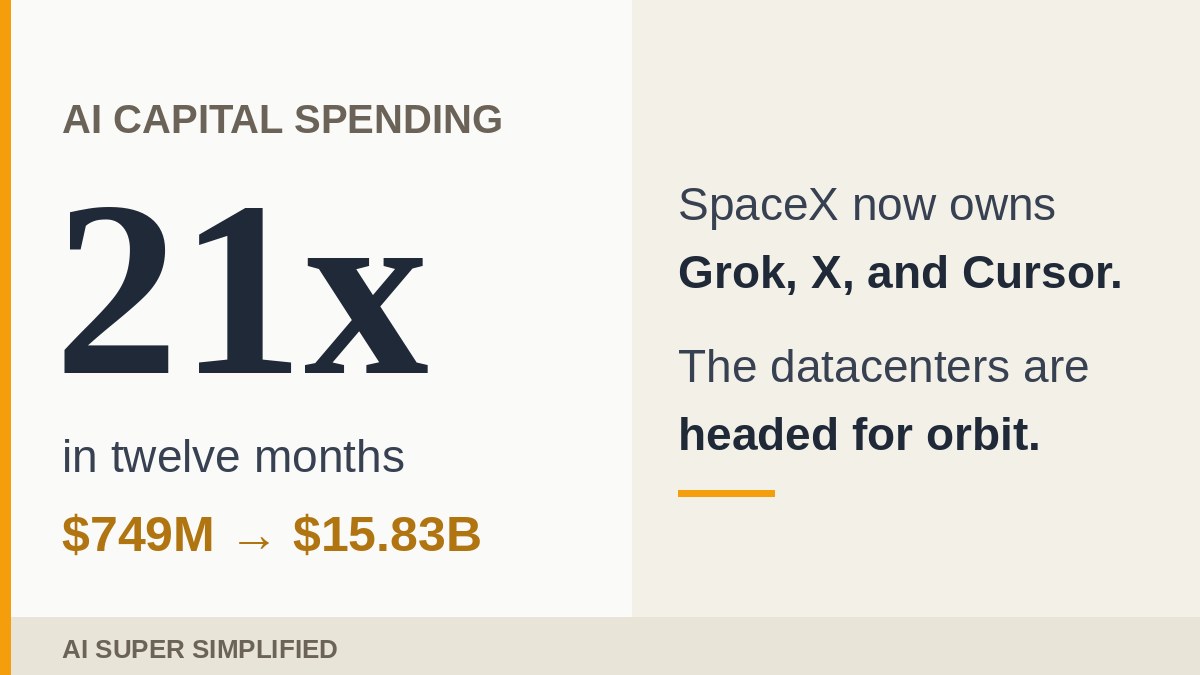
In the second quarter of 2025, SpaceX spent $749 million on artificial intelligence.
In the second quarter of 2026, it spent $15.83 billion.
That is not a typo and it is not a rounding artifact. It is a twenty-one-fold increase in twelve months, disclosed in the company's own earnings filing on August 4. It is also the number behind a week of trading so violent that roughly $300 billion of market value sloshed around in five days — a 13% collapse on Wednesday, a 15.8% surge on Friday.
Most of the coverage framed that as a story about Elon Musk having a bad week. It isn't. It's a story about who owns the software you use, and it has a much more interesting answer than it did a year ago.
Three acquisitions most people missed
Run the timeline, because the individual stories got much less attention than the share price did.
February 2026. SpaceX acquired xAI in an all-stock deal valuing the combined company at roughly $1.25 trillion. Because xAI had already absorbed X — the platform formerly called Twitter — that single transaction handed a rocket company both a frontier AI lab and a social network. By July the lab had stopped existing as a separate entity altogether, folded into a SpaceX division called SpaceXAI.
June 12, 2026. SpaceX went public on the Nasdaq under the ticker SPCX, priced at $135 a share. It opened at $150 and closed its first day near $161 — the largest initial public offering ever completed.
June 16, 2026. Four days later, SpaceX exercised an option it had quietly secured back in April and agreed to buy Anysphere, the maker of Cursor, for $60 billion in stock. Cursor had reached $2 billion in annual recurring revenue by February, one of the fastest climbs any software company has ever recorded. The deal is expected to close this quarter, pending regulatory approval.
Four days between ringing the opening bell and announcing the biggest startup acquisition in history is an unusual amount of urgency. It is worth asking what the hurry was.
The money is going somewhere specific
Here is where the story stops being about corporate shopping and starts being about physics.
SpaceX's argument is that the constraint on AI is no longer chips. It is power, land, and cooling — three things Earth is running short of near the places datacenters want to be. Its proposed answer is to move the compute off the planet entirely: solar power without a night, vacuum for cooling, and no municipality to negotiate with over a water table.
This is not a conference-stage hypothetical. On January 30, SpaceX filed an application with the FCC to operate a constellation of up to one million satellites dedicated to space-based data processing, flying between 500 and 2,000 kilometers up. The company unveiled the satellite — designated AI1 — on June 8, the week of its IPO. Two prototypes are slated to fly in early 2027, with deployment from 2028.
The quarterly numbers line up with that ambition rather than contradicting it. Compute capacity reached 1.4 gigawatts, up from 1.0 gigawatt in the previous quarter. The company signed $14.1 billion in cloud services agreements — customers paying for access to compute. The AI division's revenue grew 247% year over year to $2.56 billion.
So the spending is not aimless. It is a specific, capital-intensive, physically demanding bet with a stated delivery date two years out.
What actually happened last week
The Q2 report landed on August 4 and, read plainly, it was good. Revenue of $7.8 billion, up 92% from $4.1 billion a year earlier, ahead of what analysts expected. Adjusted EBITDA of $3.5 billion, up 191%. The net loss narrowed to $541 million from $1.0 billion. Starlink passed 12 million subscribers, double the year before.
The market sold it off anyway, because of one line: total capital expenditure of $18.37 billion for the quarter, against forecasts closer to $13 billion. For the first six months of the year, capex hit $28.5 billion versus roughly $7 billion in the same stretch of 2025.
Shares fell about 13% on Wednesday. Then, on Thursday, the first insider lockup expired and 911.5 million shares became eligible for sale — the day investors had been dreading for two months.
The selling never arrived. On Friday the stock rose 15.8%, its biggest single-day gain since the debut, closing at $133.11 and finishing the week up 22.8%.
That is not a company in trouble. That is a market with no settled opinion about what orbital AI infrastructure is worth — which is a reasonable position, given nobody has ever built one.
Why this lands on your desk
Strip out the rockets and the trading, and something practical is left over.
A tool many engineering teams adopted in 2023 as a scrappy startup product is being absorbed into a trillion-dollar conglomerate that also owns a frontier model, a social network, a satellite internet provider, and a launch business. Nothing about Cursor's interface changed. Everything about its corporate context did.
That pattern is not unique to this deal, and that's the actual lesson. The AI tools sitting in most workflows arrived as independent products and are steadily being consolidated into a handful of very large owners. Most teams have never written down which of their tools belong to whom — so they cannot see when four apparently independent vendors quietly become one counterparty.
This is not a reason for alarm. Consolidation often means more compute, better reliability, and faster shipping; Cursor gets access to infrastructure no independent startup could fund. It is a reason for literacy. Knowing who owns your stack is the difference between choosing a concentration and discovering one.
| Reader | Tools they named | What the audit surfaced | Largest single exposure |
|---|---|---|---|
| Engineering lead, 200-person SaaS | Cursor, Grok, GitHub, Linear | Two tools he treated as unrelated land under the same owner once the Anysphere deal closes | High - one owner, core build workflow |
| Solo marketing consultant | ChatGPT, Copilot in Word, Perplexity, Canva | Corporate owners are genuinely different, but three of four call the same underlying model family | Moderate - model dependency, not ownership |
| Analyst, mid-size finance firm | Copilot in Excel, Teams, Outlook, internal chatbot | Everything sits on one vendor surface already procured company-wide | High - but deliberate, and contractually covered |
| Creative director, small agency | Midjourney, Runway, Descript, ElevenLabs | Four independent owners, no overlap - the rare genuinely diversified stack | Low - no single owner above 25% |
What is genuinely unresolved
Three things are worth holding loosely, because the honest answer is that nobody knows yet.
The orbital thesis is unproven. AI1 has not flown. Prototypes are scheduled for early 2027 and the FCC filing requested a waiver of the milestone rules that normally require half a constellation deployed within six years. Servicing hardware in orbit is materially harder than swapping a failed rack in a building.
The Cursor deal has not closed. It is expected this quarter, pending regulatory approval, and it is an all-stock transaction — meaning the price Anysphere shareholders ultimately receive moves with SpaceX's share price, which just demonstrated it can move 15% in a day.
The spending is real regardless. $28.5 billion in six months is committed capital against a business that still posted a net loss. Morningstar values the entire AI segment at around $170 billion and describes it as closer to a call option on orbital infrastructure than a going concern. That is analyst framing rather than fact, but it is a fair description of the uncertainty.
The takeaway
The headline version of last week was a chaotic five days for the world's most-watched CEO. The version that matters is quieter: the ownership map of everyday AI tools was redrawn over eight months, mostly while everyone was looking at the share price.
Grok, X, Starlink, and — once the deal closes — Cursor now answer to the same board. The capital behind them grew twenty-one-fold in a year and is pointed at a constellation that does not exist yet.
You don't need an opinion on whether datacenters belong in orbit. You do need to know whose datacenter your tools are running in. Most people currently don't, and that's a fixable problem — it takes about ten minutes.