79% of Weekly AI Users Say It Makes Them Faster at Work. For Occasional Users, It's 38%. | Edition 346
Edition 346 — Gallup surveyed 15,482 U.S. employees. The payoff people report from AI tracks how often they use it.
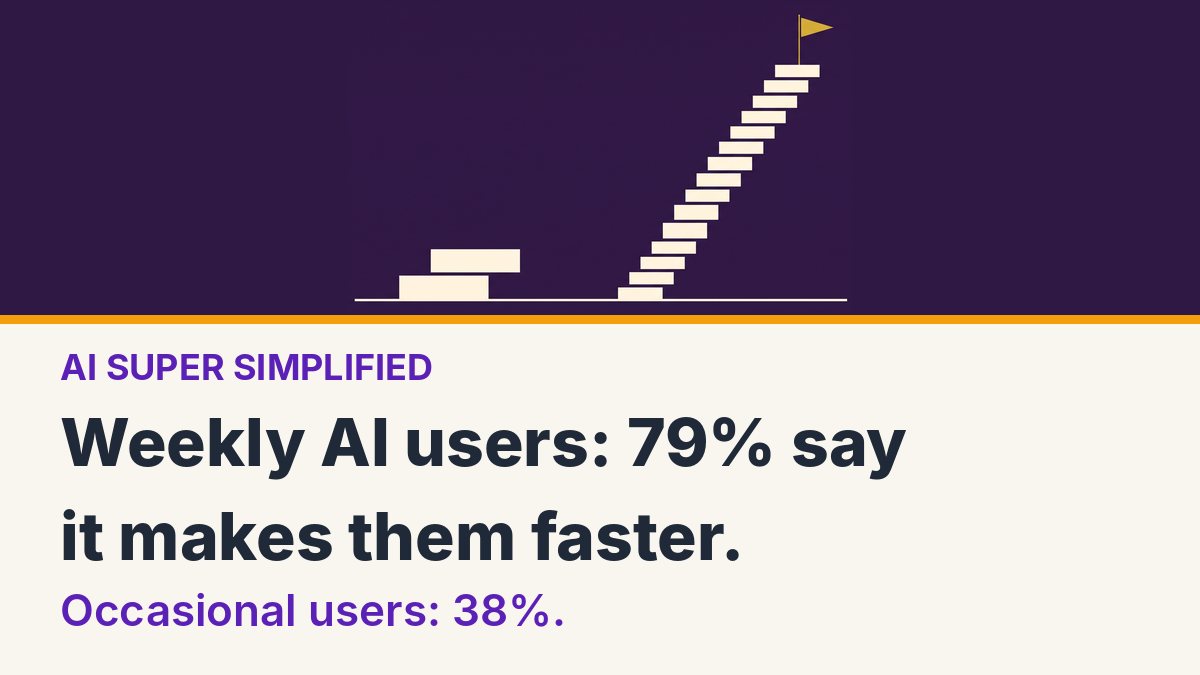
Almost four in five people who use AI at work every week say it makes them faster. Among people who use it only now and then, it’s fewer than two in five.
That gap comes from a Gallup survey of 15,482 U.S. employees published on October 6, and it shows up on all four benefits Gallup reported. The catch is how few people are on the high side of it. Only 28% of employees use AI at least weekly, and 54% said they had not used it in their job.
What Gallup found
The numbers come from the American Job Quality Study, a partnership between Gallup, Jobs for the Future and The Families & Workers Fund. The survey ran from January 26 to March 24, 2026. Of the 15,482 employees in it, 7,845 had used AI in their job at least a few times in the past year.
Among those AI users, 63% said it helps them do their job faster. 56% said it helps them find more creative solutions. 47% said it lets them spend more time on the most interesting parts of the job, and 46% said it helps them produce higher-quality work.
Then Gallup split the users in two: regular users, who use AI daily or weekly, and what it calls irregular users, who use it less often. The difference is large on all four questions.
Faster: 79% of regular users, 38% of irregular users.
More creative solutions: 67% vs. 39%.
More time on interesting work: 61% vs. 27%.
Higher-quality work: 59% vs. 26%.
Who the weekly users are
They are not a random slice of the workforce. College graduates are more than twice as likely as people without a degree to use AI daily or weekly, 40% to 17%. Managers are ahead of non-managers: 37% of managers are regular users, compared with 25% of individual contributors.
It also depends heavily on the job. Roughly half of employees in professional and business services, finance, and information and media use AI regularly. In healthcare support, manufacturing production and retail sales, 70% to more than 80% say they never use it in their role.
Many workers also want more say over new technology: 52% of all employees said they have less influence over the adoption of new technology at work than they would like.
Two cautions before you read too much into it
This is what workers say, not what was measured. Gallup is explicit that the findings are employees’ own assessments, and that they don’t establish whether employers would judge the effects the same way. Nobody timed anyone.
It shows a link, not a cause. People who get a lot out of AI probably use it more, and people in jobs where it fits have more chances to use it. The survey can’t tell you that using AI more would make any one person faster.
One more thing AI users reported: 31% said their AI use had led their employer to ask them to take on more responsibilities. Among those who say AI makes them faster, it’s 37%. Getting faster doesn’t always mean getting time back.
What it means for you
If you tried AI a few times and shrugged, you’re in the group that reports the least. That doesn’t prove more use would change your mind, but it is a cheap thing to test. Pick one task you do every week, such as a status report, a meeting summary or a first draft, and use AI for it every week for a month. Then decide.
If you manage people, don’t assume they use it the way you do. Managers are more likely to be regular users than individual contributors. Ask your team what they use it for, and what stops them.
Ask before you roll something out. About half of employees say they have less say over new technology at work than they would like. The people doing the task usually know which part of it is worth handing to AI.
Decide what the saved time is for. If faster work simply turns into more work, say so up front, and say what’s in it for the person doing it.
The usual worry about AI at work is who it will replace. This survey points at something quieter and closer: the people who use it every week are the most likely to report benefits, and they are more likely to already hold what Gallup counts as a quality job: 52% of weekly users do, compared with 32% of workers who never use AI. The encouraging part is that the entry fee is low. It’s one task, once a week.