Reverse-Engineering a Factory Part Used to Cost $1,500. Backflip AI Does It for $10. | Edition 315
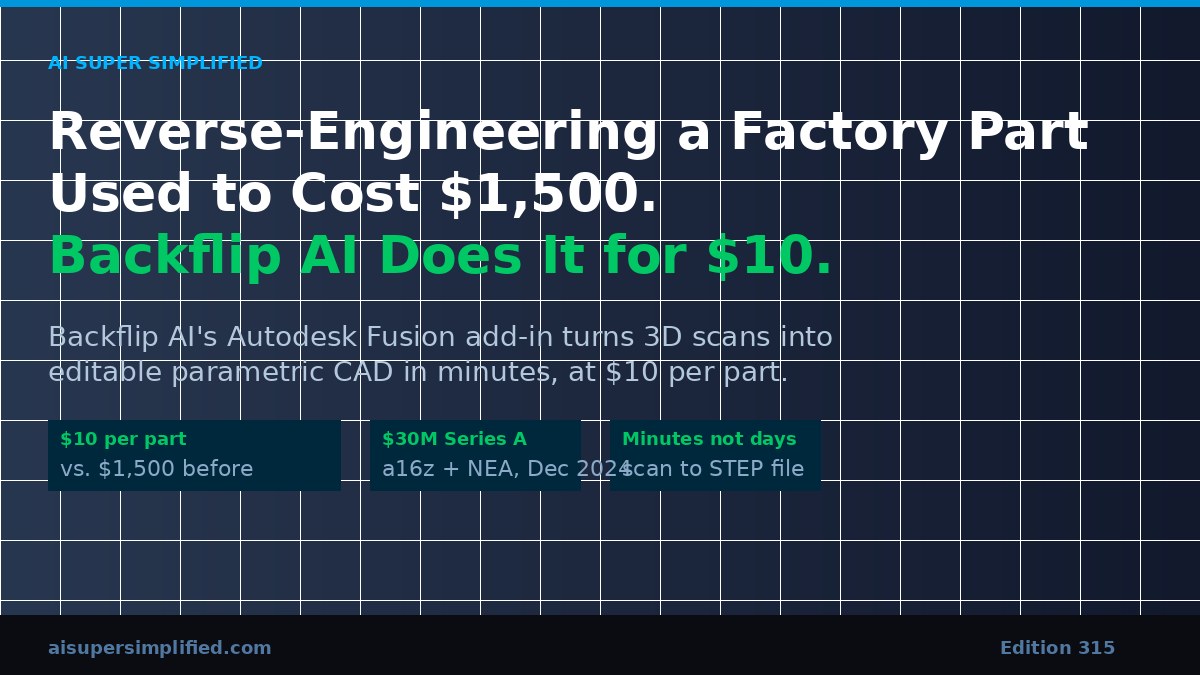
Backflip AI's Autodesk Fusion add-in turns 3D scans into editable parametric CAD in minutes, at $10 per part versus the old $1,500.
Walk the floor of most manufacturing facilities and you will find a quiet problem hiding in plain sight: the parts that keep the operation running have no digital record. Machines that have run for decades, fixtures built by machinists who retired years ago, spare parts sourced from suppliers who went under - none of it in a file anyone can open and modify.
According to Greg Mark, CEO of Backflip AI, most factories have digital CAD models for less than one percent of the parts actually in use on their floors. The rest exist only as physical objects. When something breaks, you either find a supplier who still makes it, pay someone to reverse-engineer it from scratch, or discover that you cannot replace it at all.
Reverse engineering a part the conventional way - hiring a skilled CAD technician to spend three to five hours rebuilding it from a 3D scan - typically costs around $1,500. Last week, Backflip AI launched a CAD Copilot add-in for Autodesk Fusion that does the same job in minutes, at roughly $10 per part.
Why most factory parts have no digital record
The one-percent figure is worth dwelling on. It is not that factories lack CAD software - most have it. The problem is that CAD software was used to design new parts, not to document existing ones. A part that predates digital tooling, or that was built on the shop floor without formal engineering documentation, has no file. When it wears out or breaks, whoever needs to replace it has to figure out what it is from the physical object itself.
Reverse engineering is the path back to a digital record. You scan the part with a 3D scanner, which produces a mesh - a surface made from thousands of triangles, accurate in shape but useless to a CAD system that expects features: extrusions, fillets, booleans, and mate constraints. Turning a mesh into a feature tree has historically required a trained CAD technician with hours to spare and specialized software.
The bottleneck is not the scanning. Industrial 3D scanners have gotten faster and cheaper for years. It is the conversion step - mesh to solid parametric model, by hand, every time - that makes systematic documentation of a facility's installed base essentially impossible at any practical cost.
What the add-in actually does
Backflip AI was founded in December 2022 by Greg Mark and David Benhaim, who previously co-founded Markforged, the industrial 3D printing hardware company that went public in 2021. After departing Markforged, they raised a $30 million Series A in December 2024, led by Andreessen Horowitz and New Enterprise Associates, and spent two years building what the company calls a CAD foundation model - trained on millions of CAD designs, learning the relationship between mesh geometry and the parametric feature operations a human engineer would use to produce it.
The add-in takes an STL or mesh file from a 3D scan and returns a parametric solid with a feature tree: extrusions, revolutions, chamfers, fillets, and pattern operations - the same operations a CAD technician would build manually. Output is a STEP file, compatible with any mechanical CAD software. Autodesk Fusion is the launch platform; the company says Onshape and other integrations are coming.
The key word is parametric. A mesh-to-solid conversion that returns a locked, featureless solid is faster than hand-rebuilding but largely useless for engineering work, because you cannot change it without starting over. Parametric output means the model has an editable history: you can adjust a dimension, cut a new hole, or run a tolerance analysis against the original scan without rebuilding from scratch. The result is a working engineering asset, not just a shape record.
Backflip reports that typical geometries reconstruct in a couple of minutes. Its website says seconds for simpler shapes. Complex or unusual geometries will take longer; the company does not publish accuracy figures by geometry type.
The economics: $1,500 per part versus $10 per part
Backflip AI puts the conventional cost at $1,500 or more per part - three to five hours of a skilled CAD technician's time, plus scanning time and revision cycles when the first attempt misses a feature. That figure comes from the company, not an independent industry study, but it is consistent with what engineering services typically charge: $75 to $150 per hour for skilled CAD work, times three to five hours.
The Backflip subscription starts at $20 per month. The company estimates the effective per-part cost at roughly $10, depending on volume and complexity. That is not a precision comparison - throughput varies by geometry - but the order of magnitude is real: four figures per part versus low two figures per part.
More practically: this changes who can afford to document parts and how many. At $1,500 per part, reverse engineering is a selective activity, reserved for components where the replacement risk justifies the cost. At $10 per part, it becomes something you can run continuously - a background process that a maintenance team works through systematically rather than managing as a special project for critical parts only.
| Step | Manual process | Backflip AI add-in |
|---|---|---|
| Scan the physical part | 30 min to 2 hours (varies by part complexity) | Same - scanning is not automated by the add-in |
| Convert mesh to parametric CAD | 3 to 5 hours of skilled technician time | A couple of minutes (Backflip's reported figure) |
| Cost of conversion step | $1,500 or more per part (Backflip's estimate) | ~$10 per part ($20/month subscription) |
| Output has editable feature tree (parametric) | Yes - if the technician builds it correctly | Yes - the core claim of the product |
| Works inside Autodesk Fusion natively | No - separate process and software | Yes - native add-in |
| Engineer review required before production | Yes | Yes |
What this changes for manufacturers
The facilities this matters most to are the ones with large installed bases of undocumented parts: discrete manufacturers, job shops, maintenance and repair operations, aerospace MRO, facilities teams responsible for aging infrastructure. If you maintain equipment that predates your current CAD tooling, source used machinery and need to document what you bought, or depend on institutional knowledge held by a handful of machinists, you have some version of this problem.
The practical shift is not just cost - it is scope. At the old price, you made a list of which parts were worth documenting. At $10 per part, you can stop making that list. The constraint moves from economics to throughput: how fast can your team scan parts? The conversion step - the historic bottleneck - is no longer where the time goes.
Two limits are worth naming honestly. The Backflip model was presumably trained on conventional, machinable geometry - the types of shapes that appear in industrial CAD databases. Complex organic surfaces, internal geometry only visible in cross-section, or parts with unusual construction may not convert as cleanly; the company does not publish accuracy figures by geometry type. And AI-generated CAD output should be reviewed by an engineer before it goes to production. The model reconstructs what it predicts the part probably is. For routine symmetric geometry, that prediction is likely to be correct. For anything safety-critical, verify against the physical part before cutting metal.
The takeaway
Converting mesh geometry to parametric CAD using machine learning is not a new research idea - the problem has attracted academic attention for years. What this launch represents is a productized version of that idea: a native add-in inside the tool most manufacturing engineers already use, at a price point that makes systematic use practical rather than exceptional.
That is usually how a capability moves from boutique to baseline. Not the research - the product wrapper and the price. For the manufacturers where this lands, the question shifts: no longer which parts can we afford to document, but how fast can we work through the ones we never documented before.