Google's New AI Writes 8 Times Longer Answers. The Scorecards Can't Agree Who's Smartest. | Edition 352
Edition 352 — Gemini 4 Argon vs. Claude Opus 5.5 vs. ChatGPT's GPT-6 models: what each is best at, and what it costs.
Google just opened its most powerful AI to paying developers and Google AI Pro and Ultra subscribers.
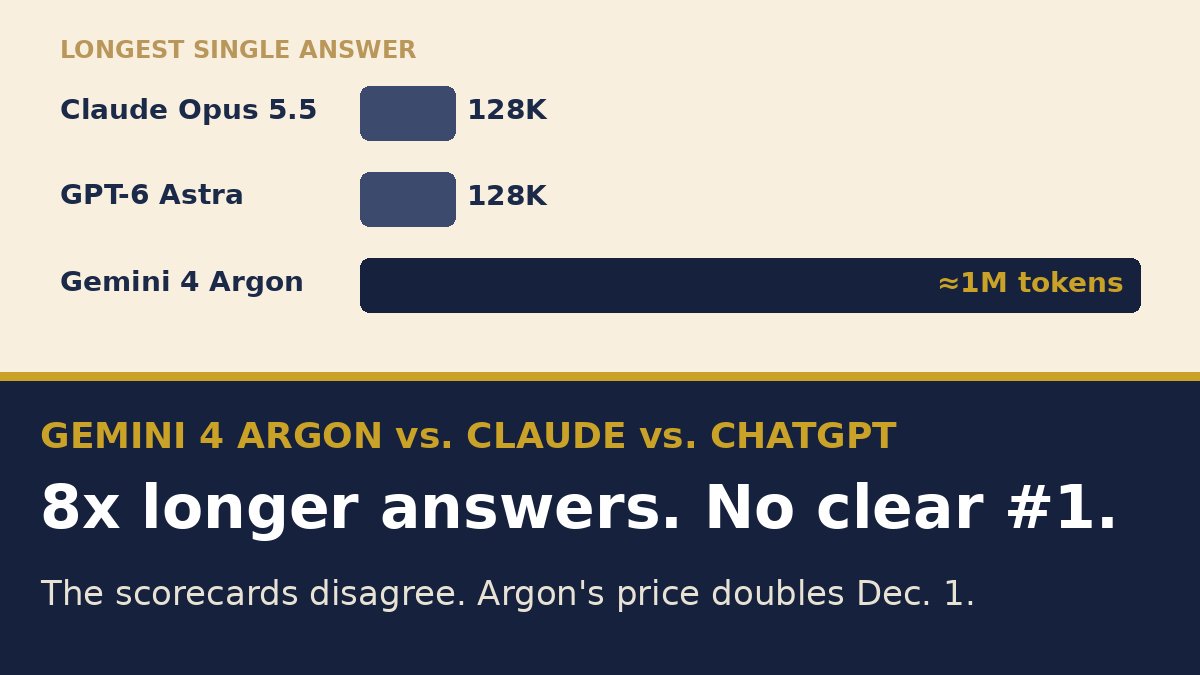
Gemini 4 Argon went on general release on Oct. 13, two weeks after Google first gave it to a vetted group of security professionals. Its headline trick: through its developer API, it can write up to about 1 million tokens in a single answer. That’s roughly 750,000 words, and about 8 times the 128,000-token limit on Claude Opus 5.5 and OpenAI’s GPT-6 Astra.
Most people will never need an answer that long. Developers will: it means one run can produce a whole software project, a full contract comparison, or a transformed dataset without being chopped into pieces.
What else is new
Adjustable thinking. You can set it to think a little, a medium amount, or a lot. More thinking is slower but better on hard problems.
It can use a computer. Clicking through screens and websites is supported, though Google still labels it a preview.
It reads almost anything. Text, images, video, audio and PDFs go in; text comes out.
Robots. Google says Argon scored 87% on a test of physical-world reasoning, ahead of every other frontier model. In one demo, it watched a video of cornhole, wrote a simulation of the game, and a humanoid robot built by Apptronik then sank seven shots in a row.
How it stacks up
Every company publishes tests it wins, so start with the independent scorekeepers, who don’t agree. Argon is first on the Vals Index, which tests finance, legal, tax and coding work, and on LMArena’s text leaderboard, where people vote on answers without knowing which AI wrote them (its spot there is still preliminary). Artificial Analysis, which combines a set of hard tests into one score, puts Claude first, and also shows what each model costs to run:
Claude Opus 5.5 (Anthropic): 58, first place at its maximum setting, which is also the priciest: about $5.98 per test task. At its “high” setting it scores 54 for about $1.82. List price $4 per million tokens in, $20 out.
Gemini 4 Argon (Google): 53. About $1.99 per task at the introductory price of $2 in, $10 out. On Dec. 1 that rises to $4 and $20, the same as Opus.
GPT-6 Astra (OpenAI): 53. About $3.26 per task. The priciest of the four per token, at $10 in and $50 out.
GPT-6.1 Sol (OpenAI): 52. The bargain: about 72 cents per task, at $2 in and $10 out.
Compare all four side by side below, and flip the switch to see Argon at its Dec. 1 price.
Google’s own chart
Google’s chart tells a sharper story in its favor. On a test of tracing connections through extremely long inputs, up to 1 million tokens, Argon scored 84.2%, against 71.8% for Astra and 66.8% for Opus. On a legal-work test from the legal AI company Harvey, it scored 19.6%, against 5.4% and 3.8%. But on Terminal-Bench, a coding test on that same chart, Opus beat it, 66.4% to 57.4%, and Argon finished last of the four models Google charted.
Where you can use them
Argon is in the Gemini app for Google AI Pro and Ultra subscribers. Opus 5.5 is on paid Claude plans. GPT-6 Astra is in ChatGPT Work and Codex for Plus subscribers and up, but in regular chats only on Pro, Business and Enterprise plans. GPT-6.1 Sol is in ChatGPT Work and Codex, but not yet in regular chats.
What it means for you
There is no single best model anymore. Argon for very long documents, video and huge outputs. Opus for the hardest reasoning and coding. Sol when cost matters most.
Check the date on any price. Argon’s cheap rate ends Nov. 30. Compare it at the Dec. 1 price, not today’s.
Test on your own work. Benchmarks are a shortlist, not a verdict. Give your three most common tasks to each model before you switch or pay for anything.
| Claim | Figure | Source |
|---|---|---|
| Gemini 4 Argon general release | Oct. 13, 2026 (first released Sept. 30 to vetted security professionals) | Google, Oct. 13, 2026 |
| Argon’s longest single answer | Up to 1,048,576 tokens with long decode (65,536 by default) | Gemini API model documentation |
| Max answer length, Claude Opus 5.5 and GPT-6 Astra | 128,000 tokens each | Anthropic and OpenAI model documentation |
| Thinking levels, computer use, inputs | Low/medium/high; computer use in preview; text, image, video, audio, PDF | Gemini API model documentation |
| Physical-world reasoning test (ERQA) | 87% | Google, Oct. 13, 2026 |
| Cornhole demo on Apptronik’s Apollo robot | Seven shots in a row | Google, Oct. 13, 2026 |
| Artificial Analysis Intelligence Index | Opus 5.5 58 (max) / 54 (high); Argon 53; Astra 53; Sol 52 | Artificial Analysis, mid-October 2026 |
| Cost per Artificial Analysis task | Opus $5.98 (max) / $1.82 (high); Argon $1.99; Astra $3.26; Sol $0.72 | Artificial Analysis, mid-October 2026 |
| Vals Index | Argon first | Vals AI, Oct. 2026 |
| LMArena text leaderboard | Argon first (preliminary) | LMArena, Oct. 2026 |
| Argon list price | $2 / $10 per million tokens through Nov. 30; $4 / $20 from Dec. 1 | Gemini API pricing |
| Other list prices | Opus 5.5 $4 / $20; GPT-6 Astra $10 / $50; GPT-6.1 Sol $2 / $10 | Anthropic and OpenAI pricing |
| Long-input tracing test (GraphWalks, 256K–1M) | Argon 84.2%, Astra 71.8%, Opus 66.8% | Google comparison chart, as reported by VentureBeat |
| Harvey legal agent test | Argon 19.6%, Astra 5.4%, Opus 3.8% | Google comparison chart, as reported by VentureBeat |
| Terminal-Bench 4.0 coding test | Opus 66.4%, Argon 57.4% (Argon last of four) | Google comparison chart, as reported by VentureBeat |
A year ago the question was which AI is best. Now three companies each have a credible claim to the top, depending on who’s keeping score. That’s good news for you: it means the right answer is whichever one does your work best, and you can find that out in an afternoon.