AI Chatbots Showed a Fake or Dead Store in 9% of Shopping Answers. On Perplexity, 15%. | Edition 381
Edition 381 — A brand-protection firm asked ChatGPT, Gemini and Perplexity where to buy 151 brands. Risky sites rarely came with a warning.
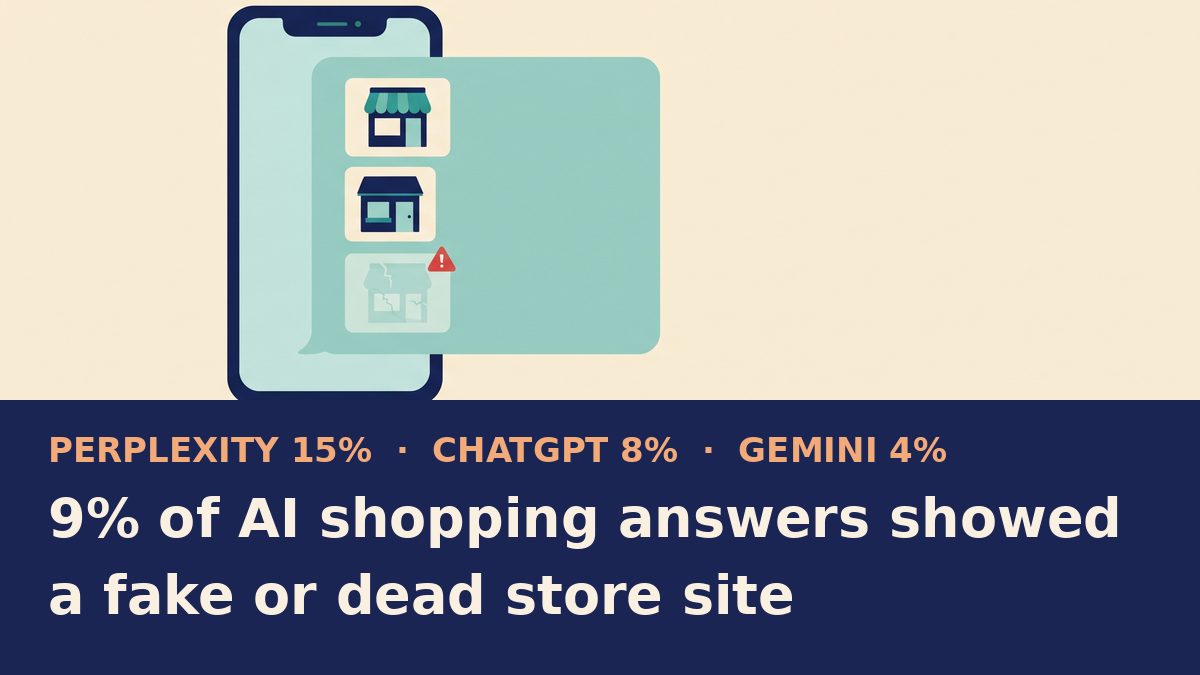
Ask an AI chatbot where to buy something and you usually get a tidy list of stores. A new test found that sometimes one of those stores isn’t real, or isn’t there anymore.
Podqi, an IP-protection firm that hunts down fake websites for brands, asked the logged-out, consumer versions of ChatGPT, Gemini and Perplexity the same five where-to-buy questions about 151 brands, in two rounds of testing in September. Across 6,795 answers, 9% showed the shopper at least one risky site: one that appeared to impersonate a brand, offered suspected counterfeits, or was dead, with nothing to buy.
What the test found
- The rate varied by chatbot. Perplexity showed a risky site in 15% of its answers, ChatGPT in 8% and Gemini in 4%. Same questions, same brands, same days.
- Recommended, not flagged. In 57% of the answers that showed a risky site, the chatbot suggested it as a place to shop. In 34%, it mentioned the site without comment. Only 9% warned the shopper away. Overall, recommendations outnumbered warnings 6.3 to 1.
- ChatGPT warned most often, in 24% of its risky answers, the best of the three.
- “Regional website” questions were the riskiest. When asked whether a brand ships internationally and what its regional websites are, 16% of answers showed a risky site. In those answers, 36% of the risky sites used a country ending or region name in the web address, the kind of detail that makes a fake look official.
- About half the risky sites were dead. Podqi reviewed 4,437 web domains the chatbots mentioned and flagged 718 as risky: 351 fake and 367 dead.
- Big brands weren’t spared. Of 125 risky answers about enterprise brands, 4 warned the shopper. The other 121 didn’t.
One encouraging sign: the share of risky answers fell from 12% in the first round of testing to 7% in the second, which covered a different set of brands. Podqi says the brand mix doesn’t explain the drop.
Read it with care
Podqi sells brand protection: it finds lookalike websites and files takedowns. A study showing that chatbots send shoppers to fakes is good for its business. The answer data came from AI search company Gauge, and the test covered one month, the logged-out, consumer versions of each chatbot, and 151 brands. Podqi measured how often a risky site showed up, not how many people were actually scammed. Treat the percentages as a snapshot, not a standing rate.
The underlying problem is real, though. In 2024, online shopping was the second most-reported fraud category at the Federal Trade Commission: 383,441 reports and $432 million in reported losses.
What to do before you buy
- Let AI research, not pick the link. Use it to compare products, then go to the brand’s own website by typing an address you already know.
- Reach country stores through the brand’s main site. Podqi’s own advice is to treat any regional or “official” web address an AI supplies as unverified.
- Read the web address letter by letter. The Better Business Bureau says a spelling error in the domain name means you’re not on the official site.
- Search the store’s name plus “scam” or “complaint.” The Federal Trade Commission recommends it.
- Look for a real address and phone number. The BBB says legitimate online stores should list both.
- Be wary of bargain prices on big brands. The FTC warns they could be counterfeit or stolen. A web address that starts with https only means the connection is encrypted, not that the store is real, the FTC notes.
- Pay by credit card. The FTC says it best protects you if something goes wrong. Walk away from any seller that insists on gift cards, wire transfers, payment apps or crypto.
The prompt below turns any chatbot into a store-link checklist: it asks about the link and what you see on the page, one question at a time, and tells you what to check before you pay.
| Claim | What we found | Source |
|---|---|---|
| 9% of 6,795 answers | Showed the shopper at least one risky site (impersonation, suspected counterfeit, or dead) | Podqi, AI search brand-risk study |
| 151 brands, 5 questions | Logged-out consumer versions of ChatGPT, Gemini and Perplexity; two rounds of testing in September; answer data from Gauge | Podqi, AI search brand-risk study |
| Perplexity 15%, ChatGPT 8%, Gemini 4% | Share of each chatbot’s answers that showed a risky site | Podqi, AI search brand-risk study |
| 57% / 34% / 9% | Of answers showing a risky site: recommended it / mentioned it without comment / warned away | Podqi, AI search brand-risk study |
| 6.3 to 1 | Recommendations outnumbered warnings | Podqi, AI search brand-risk study |
| ChatGPT warned in 24% | Share of ChatGPT’s risky answers that carried a warning | Podqi, AI search brand-risk study |
| 16% on regional-website questions | The riskiest question; 36% of risky sites in those answers used a country ending or region name | Podqi, AI search brand-risk study |
| 4,437 domains, 718 risky | 351 fake and 367 dead | Podqi, AI search brand-risk study |
| 4 of 125 | Risky answers about enterprise brands that warned the shopper | Podqi, AI search brand-risk study |
| 12% to 7% | Share of risky answers, first round vs second round | Podqi, AI search brand-risk study |
| Podqi sells brand protection | Lookalike-site detection and takedowns | Podqi, AI search brand-risk study |
| 383,441 reports, $432 million | “Online Shopping and Negative Reviews” category, 2024: reports and reported losses; second most-reported fraud category | FTC Consumer Sentinel Network Data Book 2024 |
| Shopper checks | Search “scam”/“complaint”; credit card; avoid gift cards and wire transfers; https means encrypted, not legitimate | FTC, Online Shopping tips |
| Domain spelling, address and phone | Signs of a fake or legitimate store | Better Business Bureau, How to identify a fake website |
Has an AI ever sent you somewhere strange?
Hit reply and tell me: have you bought something through a link a chatbot gave you, and did the store turn out to be what it said? I read every response.