AI Users With Training Saved 22% of Their Working Hours. Those Without Saved 13%. | Edition ###
Edition ### — A 3,001-person study links AI training to more use and bigger time savings. 4 moves for your next team meeting.
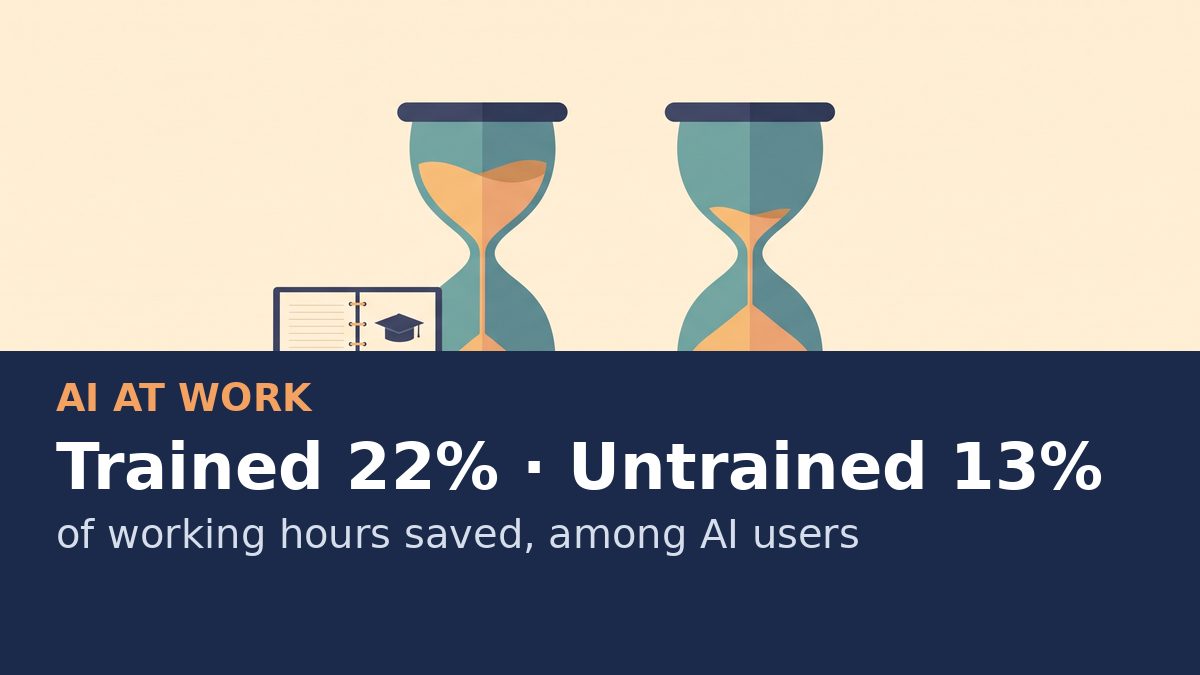
Most teams have been handed an AI tool by now. Many haven’t been shown how to use it. A study from the London School of Economics and the consulting firm Protiviti puts a number on that gap. Among employees who use AI, those with any AI training in the past year reported saving 22% of their working hours with it. Those with no training reported saving 13%.
Trained employees were also far more likely to use AI at all: 93% of them did, against 50% of those with no training. If you manage people, training is a lever you can pull this month.
What the study found
This is the third year the LSE’s Inclusion Initiative has run the survey with Protiviti. This round asked 3,001 professional employees, most of them in Germany and the UK, with about 1 in 5 in the US. The headline findings:
- Use is now normal. 74% of employees use AI at work, up from 29% in 2024.
- Training goes with use. 93% of employees with AI training in the past 12 months reported using AI, against 50% of those with none. “Training” counted company-provided or self-guided learning.
- Training goes with time saved. Among employees who use AI, the trained reported saving 22% of their working hours. Those without training reported 13%. The report says the gap holds across every generation.
- Tools alone don’t close it. Where the employer provided AI tools, 96% of trained employees used AI, against 78% of untrained ones.
- Training isn’t evenly spread. 66% of Gen Z employees had AI training in the past year, against 40% of baby boomers.
All of these figures are self-reported, and the researchers are careful about what they prove. The report says it cannot conclude that the relationships are causal. One example the researchers give: employers that invest in AI tools also tend to provide training. Once they controlled for factors like that, training was still linked to more time saved, though the report calls the effect modest.
The part managers miss
Two findings point at pressure, not skill. First, 48% of employees worry about being judged for not using AI enough, against 20% who worry about being judged for using it. Second, AI users said they save an average of 19% of their working week, and put 72% of that saved time back into other work.
Grace Lordan, founding director of the Inclusion Initiative at the LSE, put it this way: “Where those time savings go matters as much as the size of the savings.” Matt Duncan, a managing director at Protiviti, made the same point from the business side: “Simply absorbing those gains into existing workloads leaves much of AI’s potential untapped.”
The study also found no consistent link between AI use or training and how employees believe their leaders see their work.
4 moves before your next team meeting
These are our suggestions, built on the study’s findings.
- Train everyone, not just the keen ones. Even an hour on your team’s real tasks is a start, as long as it’s useful: the report says training quality appears to matter as much as taking part. Start with whoever hasn’t been trained yet.
- Say out loud what’s expected. Nearly half of employees worry about being judged for not using AI enough. Tell your team where AI is welcome, where it isn’t, and that nobody is being scored on how much they use it.
- Decide where saved time goes. If you don’t, it fills up with more of the same work. Pick one thing the saved hours are for, like a project that keeps slipping or time for training.
- Turn one task into a routine. In the report, the 39% of AI users who had built AI into a standard way of working reported saving 27% of their time, against 14% for those who hadn’t. Pick one recurring task and write down how the team does it with AI.
The prompt below does the planning for you. It interviews you about your team, one question at a time, and writes a 30-day AI training plan.
| Claim | What we found | Source |
|---|---|---|
| Sample | 3,001 professional employees globally; third annual report | LSE Inclusion Initiative + Protiviti, press release, protiviti.com |
| Where they work | Germany 36.5%, UK 29.6%, US 18.6%, the rest elsewhere | LSE Inclusion Initiative + Protiviti, “Beyond the Technology: Who Really Captures AI’s Gains at Work” (report) |
| Use at work | 74% use AI at work, up from 29% in 2024 | LSE Inclusion Initiative + Protiviti, press release, protiviti.com |
| Training and use | 93% of trained employees reported using AI vs 50% of those with no training | LSE Inclusion Initiative + Protiviti, press release, protiviti.com |
| What counts as training | Any AI training in the past 12 months, including self-guided | LSE Inclusion Initiative + Protiviti, “Beyond the Technology: Who Really Captures AI’s Gains at Work” (report) |
| Training and time saved | Among AI users: 22% of working hours saved (trained) vs 13% (no training), self-reported | LSE Inclusion Initiative + Protiviti, press release, protiviti.com |
| Employer-provided tools | With employer-provided AI tools: 96% use among trained employees vs 78% among untrained | LSE Inclusion Initiative + Protiviti, press release, protiviti.com |
| Training by generation | 66% of Gen Z received AI training vs 40% of baby boomers | LSE Inclusion Initiative + Protiviti, press release, protiviti.com |
| Fear of being judged | 48% worry about being judged for not using AI enough; 20% for using it | LSE Inclusion Initiative + Protiviti, press release, protiviti.com |
| Where saved time goes | AI users save an average of 19% of their working week and reinvest 72% of it in other work | LSE Inclusion Initiative + Protiviti, press release, protiviti.com |
| Standard routines | 39% of AI users have built AI into a standard way of working: 27% time saved vs 14% | LSE Inclusion Initiative + Protiviti, “Beyond the Technology: Who Really Captures AI’s Gains at Work” (report) |
| Perceived performance | No consistent link between AI adoption or training and how employees believe leaders see their work | LSE Inclusion Initiative + Protiviti, press release, protiviti.com |
| Not causal | The researchers say they cannot conclude the relationships are causal | LSE Inclusion Initiative + Protiviti, “Beyond the Technology: Who Really Captures AI’s Gains at Work” (report) |
Has your team had any AI training?
Hit reply and tell me what it was, or why it hasn’t happened yet. I read every response.