Why Smart Professionals Stopped Googling Their Competitors [#271]
There's an engine that reads the internet for you and cites every claim. Here's the exact way to put it to work.
Last week a peer of yours walked into a strategy meeting with a tight, two-page read on a rival — a quiet pricing change, a product shift nobody had announced, two job postings that gave away where they're headed next. Every claim had a source sitting right beside it. It took her about as long as refilling her coffee.
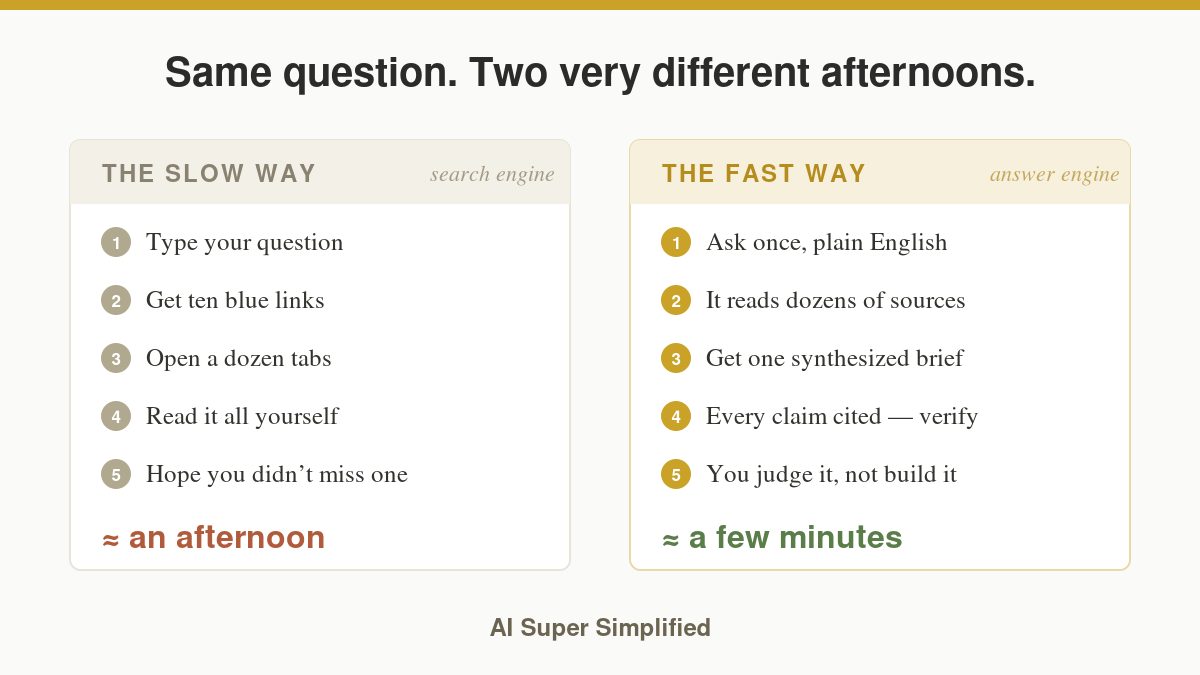
You could have built the same brief. It would have cost you an afternoon of open tabs, a dozen half-read articles, and the nagging feeling you'd missed the one page that mattered.
Here's the uncomfortable part: she isn't faster because she's sharper. She's faster because she stopped asking a tool that was never built to answer the question — and started asking one that was.
Why a search engine is the slow lane for this
Roughly nine out of ten searches worldwide still run through Google — a little over 90% of the market as of mid-2026. For "nearest dentist" or "what year did this launch," a list of blue links is exactly right.
It's the slow lane for the questions that actually move a meeting: what changed in my competitor's strategy last quarter, and how do I know it's true? A classic search hands you ten links and leaves you to do the reading, the cross-checking, and the assembling. That's the afternoon you keep losing.
What an answer engine does instead
An answer engine flips the job. Instead of returning links for you to read, it reads the sources itself, weighs them against each other, and hands back one synthesized brief — with every claim footnoted to the article, filing, pricing page, or press release it came from. You click to verify in seconds; you don't trust a black box.
Perplexity is the one your competitors have most likely already folded into their week. It stopped being niche a while ago — tens of millions of people use it every month, and the audience skews heavily professional. By its own reporting, well over half of its queries are research-style — "explain," "compare," "summarize" — and its deep mode reads hundreds of sources per question before it answers. People hand it fuller questions than they give Google, too: full sentences, not keywords, because it's built to reason toward an answer rather than match a phrase.
Watch the afternoon collapse
You ask one question — "What changed in [competitor]'s pricing and public positioning over the last 90 days? Cite every source." — and instead of links, you get a brief: the pricing move, the messaging pivot, the hiring signal, each line linked to where it came from. Your time goes to judging the answer instead of assembling it. That two-page read your peer walked in with? That's the whole trick.
It's not just Perplexity anymore
The shift went mainstream faster than most people noticed — the same capability now lives inside tools you already pay for. Google's own search answers this way: AI Mode uses Gemini to fire off a fan of parallel searches behind the scenes, then returns a synthesized, cited response — and Google says more than a billion people are already using it every month. ChatGPT searches the live web and cites what it finds. Claude does the same, and is strong when you want careful reasoning over what it pulls back. Four solid options, each with a sweet spot:
| Engine | Reach for it when… |
|---|---|
| Perplexity | You want the cleanest cited research read. It's purpose-built for this, shows its sources up front, and its deep mode scans hundreds of pages. |
| Google AI Mode | You're already in Google and want a fast, cited answer with the rest of the web one tap away. |
| ChatGPT | You want the research woven straight into a deliverable — a draft, a table, an email — in the same window. |
| Claude | You want careful reasoning over what it finds, or you're handing it long documents to analyze alongside the web. |
How to actually run it (and not get burned)
The engine does the gathering. Your job is to ask well and check fast. Three habits separate a brief you can trust from one that embarrasses you in the meeting:
1. Ask a real question, not a keyword. "Acme pricing" gets you mush. "How has Acme's pricing and positioning changed in the last 90 days, and what does it signal about their roadmap?" gets you a brief. Name the timeframe, and tell it to cite everything.
2. Click two or three citations — every time. The whole advantage is that the sources are sitting right there. Open a couple and confirm the engine read them the way it claims. Thirty seconds of spot-checking is the entire difference between research and guessing.
3. Watch the dates and the gaps. Note how fresh each source is — a confident answer built on a year-old page is a trap — and make the engine flag what it couldn't find. In a competitor read, the holes are often the most useful part.
One rule ties them together: anything stated without a link, treat as a lead to verify, not a fact. These engines are far more grounded than a plain chatbot — but the citation is the proof, not the confidence in the sentence.
The same move, three jobs
It's one habit that pays off across the whole org:
Founder — a read on a rival's last quarter becomes a sourced one-pager: pricing, launches, hiring signals, each line cited.
Sales lead — prep before a head-to-head deal becomes a talk-track: where they're weak, what they claim, how to counter it, with proof links you can stand behind.
Marketer — their messaging against yours becomes a positioning gap map: their words, your opening, and the line they can't say that you can.
None of it takes a new skill. It takes asking the right engine the right way — which is the whole game.
The tool stopped being the advantage the day everyone could download it. What you do with it before the meeting still is.
— The AI Super Simplified team