I Fed Claude a Family Card Game’s Rules. It Came Back a Website, a PDF, and a Cheat Sheet. | Edition 296
Edition 296 — A decades-old family rules sheet, turned into a mobile page, a full PDF, and a one-page cheat sheet in one sitting.
Somewhere in a relative’s files was a typed sheet of house rules for Spite and Malice — the kind of single page that survives because someone kept it in a drawer for decades, not because anyone photographed it. This week I asked Claude to turn it into something that could actually leave the house: a page anyone can read on their phone, a printable PDF, and a one-page cheat sheet short enough to glance at mid-game.
The interesting part wasn’t the card game. It was watching one messy source document turn into three different outputs — web, print, and quick-reference — without retyping it three times, and without losing the thing that made the original worth keeping: a real, specific house variation, not a generic rule set pulled off the internet.
What actually took the time
Not the rules themselves — those were already written down. The real work was three passes:
- Generalizing. The original document credited specific people by name and named the town it came from. Making it shareable meant deciding, explicitly, what to keep and what to cut — not a find-and-replace, but a real question of how much of a family document should still exist once you take the family out of it.
- Reformatting for three reading contexts. A page you read once, a PDF you print and keep with the cards, and a cheat sheet you glance at mid-game need different amounts of detail — the full version has room for context; the cheat sheet doesn’t.
- Checking the trivia. The original included a paragraph on where the game came from — a claim about a 19th-century German patience game, a bridge champion who published a book on it in 1970, and the commercial spinoff that became Skip-Bo. Those are exactly the kind of specific, checkable claims that are easy to repeat and easy to get wrong, so each one got verified against an independent source before it went anywhere public.
The rules, generalized
Here’s the result — the family-specific details stripped out, the game rules and the (verified) history left in, broken into short steps with a worked example wherever the rule text alone tends to confuse first-timers.
Spite and Malice — Official Game Rules
Players: 2 • Time: 20–45 minutes • Age: 8+
Equipment: 2 decks of playing cards with both Jokers (one RED deck, one BLUE deck)
Objective: Be the first to play all 26 cards from your Play-Off Pile onto the Center Building Piles
Setup
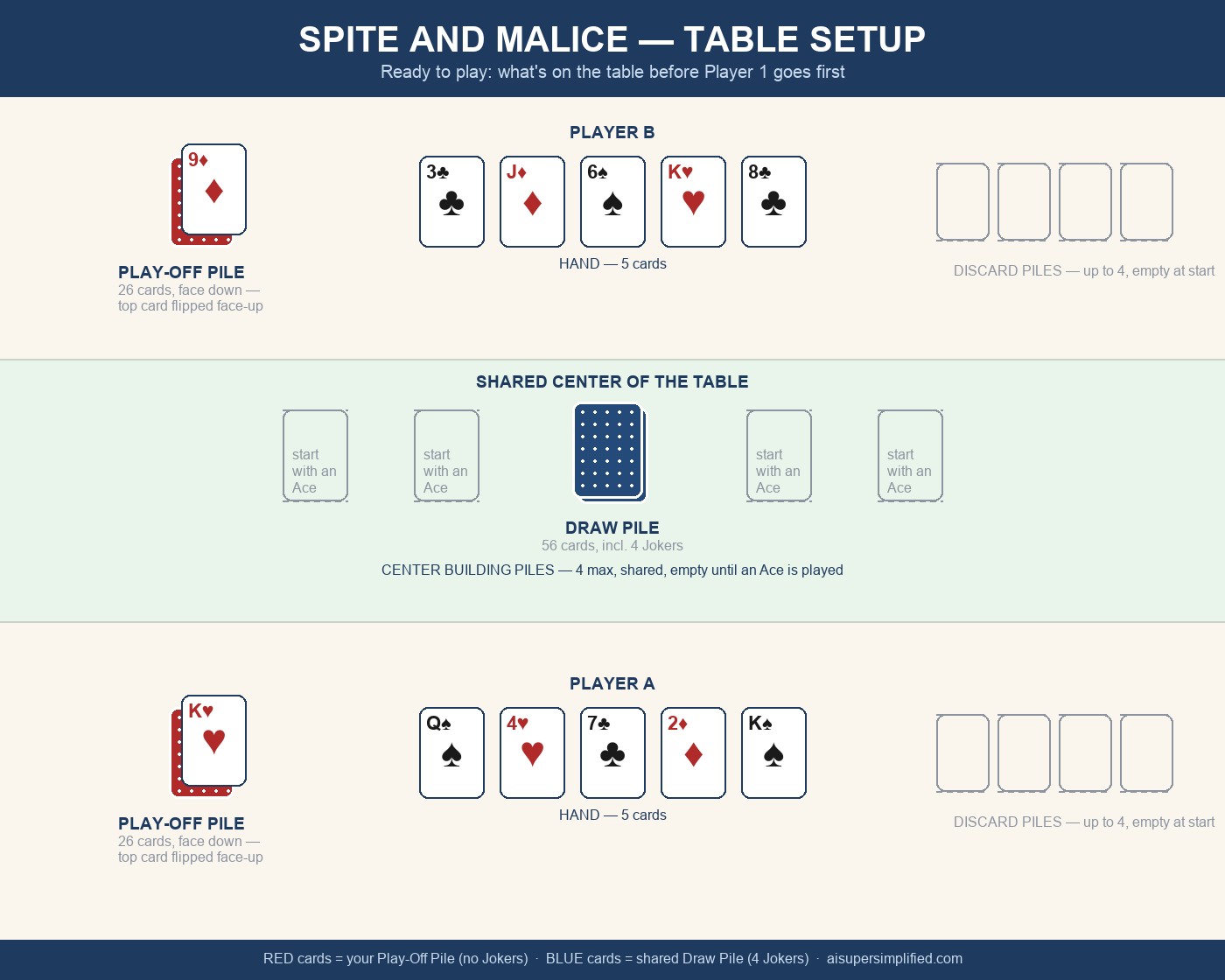
- RED deck (52 cards, no Jokers): split evenly, 26 cards each, face down — that's your Play-Off Pile. Flip your top card face-up.
- BLUE deck (56 cards, all 4 Jokers): the shared Draw Pile goes in the middle of the table. Deal 5 cards to each player's hand.
- Who deals and goes first: whoever's face-up Play-Off card is higher (King is high, Ace is low). Tied? Reshuffle both Play-Off Piles and flip again.
Example: Player A flips a 9, Player B flips a King. King is higher, so Player B deals and goes first.
The Center Building Piles
- Shared by both players, 4 piles max.
- Each pile must start with an Ace.
- Build up: A → 2 → 3 → ... → K.
- A matching number can stack on the same number.
- A completed King is removed from play and set aside.
Example: a Center Pile shows a 6. You can play another 6 on it, or the 7 to keep building up — but not an 8.
Your Discard Piles
- Yours alone, up to 4 piles.
- Any card can start a pile.
- Build down, high to low — same-on-same is OK here too.
- Only the top card of each pile is playable.
- Jokers can never be discarded.
- You can move cards between your own discard piles to keep all 4 in play.
Example: a Discard Pile shows a 7. You can play another 7 on it, or a 6 to keep building down — but not a 5.
When the Draw Pile runs low
- Set aside the current top card.
- Shuffle the rest of the Draw Pile together with any completed (King) piles.
- Put the saved card back on top.
Your turn, step by step
- Play — play as many cards as you can onto the Center Building Piles, from your hand, the top of your Play-Off Pile, or the top of any of your Discard Piles.
- Discard — end your turn by discarding exactly one card to your own Discard Piles.
- Draw — draw back up to 5 cards in hand.
Bonus: play all 5 cards from your hand without discarding, and you draw 5 more and keep playing — no discard needed that turn.
Jokers
- Wild for any card — except an Ace or a 2.
- Playable on the Center Building Piles only — never in a discard pile.
Example: a Center Pile needs a 5 next. A Joker can be played there as the 5 — but a Joker can never be played as the opening Ace or as a 2.
If you can't play
- Your turn just ends at Discard — your opponent keeps playing until they're stuck too.
- Both players stuck? Gather every card on the table — both hands, the Draw Pile, and all Discard Piles — shuffle it all together, and deal 5 fresh cards to each player. Whoever got stuck last goes first.
How to win
Be the first to play all 26 cards from your Play-Off Pile onto the Center Building Piles. Keep score across games if you're playing a series.
Where the game comes from
- Origins: descends from Crapette (also called Russian Bank), a patience game first documented in the German publication Illustrirtes Buch der Patiencen (1884–85) as Zank-Patience — literally “quarrel patience.”
- Early praise: the U.S. Playing Card Company published its rules in 1898, calling it “probably the best game for two players ever invented.”
- 1970s revival: bridge champion Easley Blackwood (1903–1992) — inventor of the Blackwood convention — saw it played on a cruise ship and published Spite & Malice: The Complete Rules and Strategy (Cornerstone Library, 1970).
- Commercial spinoff: in 1967, Minnie Hazel “Skip” Bowman of Brownfield, Texas created a boxed edition called Skip-Bo. International Games bought it in 1980; Mattel acquired the company in 1992.
Downloads
Grab the full rules to print and keep with your cards, or just the one-page cheat sheet for quick reference mid-game.
Download the Full Rules (PDF) →
Download the Cheat Sheet (PDF) →
Printing at home? The ink-saver versions drop the solid color panels and use half the ink or less — full rules · cheat sheet.
Try it on your own document
The prompt below runs the same process on whatever you’ve got — a recipe, a set of instructions, a letter. It interviews you first, asks how much personal detail to keep, and flags anything that reads like a checkable claim rather than an instruction.