
Why Your Competitors Answer in 30 Seconds What Takes You All Afternoon
The tool isn't a secret anymore. The way they're using it still is.
Last week a peer of yours walked into a strategy meeting with a tight, two-page read on a rival — new pricing, a quiet product shift, two fresh job postings that gave away where they’re headed next. Every claim had a source sitting right next to it. It took her about as long as refilling her coffee.
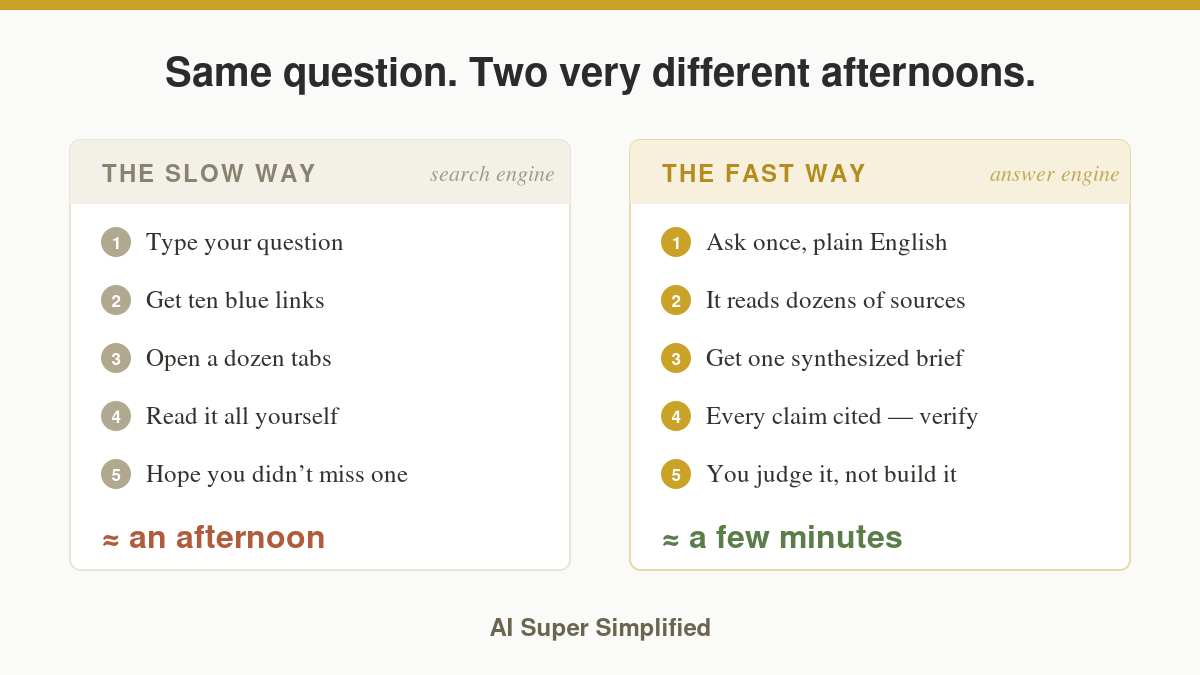
You could have built the same thing. It would have cost you an afternoon of open tabs, a dozen half-read articles, and a nagging feeling you’d missed the one page that mattered.
Here’s the uncomfortable part: she isn’t faster because she’s sharper. She’s faster because she stopped asking a search engine that was never built to answer the question.
Roughly nine out of ten searches still run through Google — a tool designed to hand you a list of links and let you do the reading. That’s fine for “nearest dentist.” It’s the slow lane for “what changed in my competitor’s strategy last quarter, and how do I know it’s true?”
The shift that’s quietly separating the fast people from the rest: an answer engine that reads dozens of sources for you and returns one synthesized brief — with every claim citing where it came from, so you can click and verify in seconds instead of trusting a black box. Perplexity is the one plenty of your competitors have already folded into their week. It isn’t obscure anymore — tens of millions of people use it every month, and it’s quietly become a default research tool on marketing, finance, and research desks. What’s still rare is using it on purpose, for the work that actually moves a meeting.
Watch how the afternoon collapses. You ask one question — “What changed in [competitor]’s pricing and public positioning over the last 90 days? Cite every source.” — and instead of links, you get a brief: the pricing move, the messaging pivot, the hiring signal, each line footnoted to the article, filing, or press release it came from. You spend your time judging the answer, not assembling it.
| Same engine, three desks |
| Founder A read on a rival’s last quarter → a sourced one-pager: pricing, launches, hiring signals, each line cited. |
| Sales lead Prep before a head-to-head deal → a talk-track: where they’re weak, what they claim, how to counter, with proof links. |
| Marketer Their messaging vs. yours → a positioning gap map: their words, your opening, sourced examples. |
None of this requires a new skill. It requires asking the right engine the right way — which is the whole game. The people beating you to the punch aren’t doing harder work. They’ve just stopped doing the slow version of it.
So we turned the afternoon into a repeatable move. It’s an interview-style prompt: answer a few quick questions about who you’re researching and why, and it builds you a clean, cited competitive brief you can drop straight into a meeting. Run it in Perplexity so the sources come back clickable.
The tool stopped being the advantage the day everyone could download it. What you do with it on a Monday morning still is.
— The AI Super Simplified team