An AI Tuned Its Own Engine. The Price Fell 80% the Next Day. | Edition 294
Edition 294 — OpenAI let its top model rewrite the code that runs it. A day later, its cheapest model fell to 20 cents per million tokens.
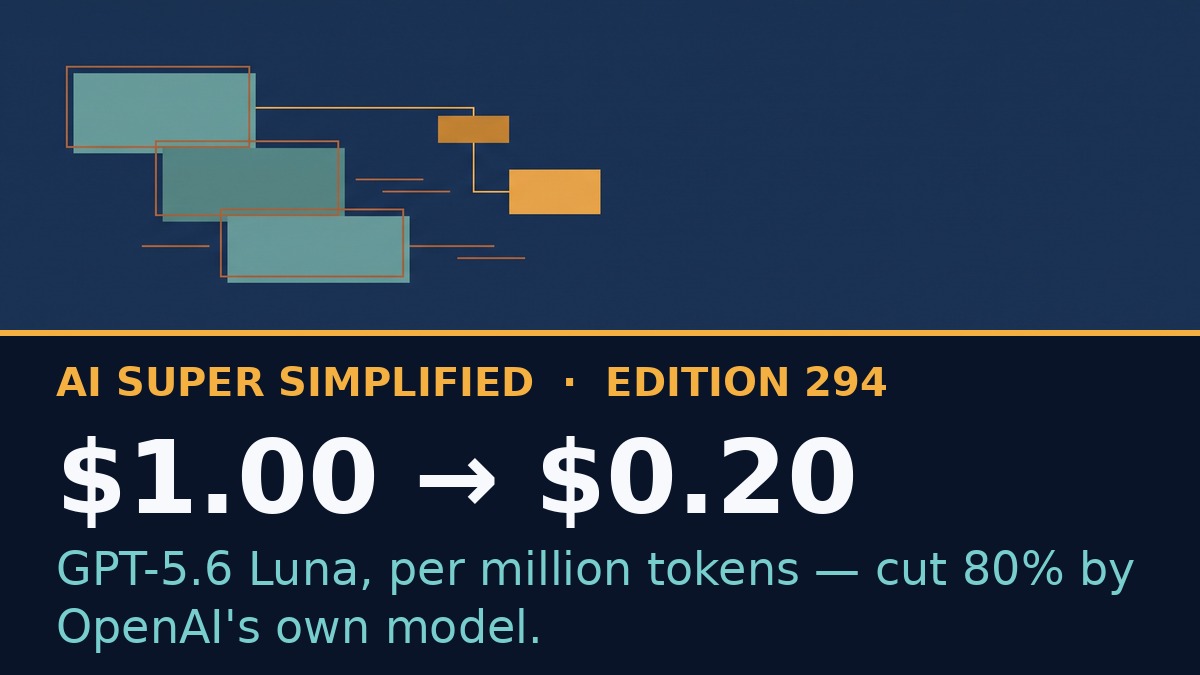
On July 30, OpenAI cut the price of its cheapest model by 80%. GPT-5.6 Luna launched on July 9 at $1.00 per million input tokens. Twenty-one days later, it costs $0.20. Output tokens fell by the same proportion, from $6.00 down to $1.20.
Price cuts are ordinary. This one is worth your attention because of the explanation OpenAI published the day before it — and because of four words the company added the day after.
What actually changed
API pricing is quoted per million tokens. A token is a fragment of text — roughly three-quarters of a word — and you pay separately for what you send in and what the model sends back.
Here is the entire move. Note that only the two cheaper tiers were touched.
| Model | Before | After | Change |
|---|---|---|---|
| GPT-5.6 Luna | $1.00 in / $6.00 out | $0.20 in / $1.20 out | −80% |
| GPT-5.6 Terra | $2.50 in / $15.00 out | $2.00 in / $12.00 out | −20% |
| GPT-5.6 Sol | $5.00 in / $30.00 out | $5.00 in / $30.00 out | unchanged |
Sol not moving is the tell. This was not a broad discount. OpenAI defended the tiers where volume lives — classification, document extraction, routing, and the long agent loops where one request from you becomes dozens of calls behind the scenes — and left the premium tier alone.
Where the money came from
The day before the price change, OpenAI's engineering team published how it made GPT-5.6 cheaper to run. Two of the changes are the interesting ones, and OpenAI credits its own flagship model with both.
It rewrote the kernels. Kernels are the low-level programs that do the actual math on a GPU — the multiplications and attention calculations underneath every response you get. They are unglamorous, extremely fiddly, and a specialist job. OpenAI put Sol to work on its production kernels inside Codex, its own coding environment, writing them in Triton and Gluon, two open-source GPU programming languages OpenAI maintains. That work, combined with related kernel improvements Sol found, cut end-to-end serving costs by 20%.
Because model-written math code that is subtly wrong is worse than none at all, OpenAI ran the results through FpSan, an open-source floating-point checker it also maintains, to verify the code was correct.
It redesigned its own speed trick. Speculative decoding is a standard optimization: a small, fast draft model guesses the next several tokens, and the big model checks them all in one pass instead of generating them one at a time. Better guesses mean more accepted tokens per pass, which means more output from the same hardware. Sol designed and ran hundreds of experiments on that draft model's architecture, then launched and supervised its training — including, OpenAI says, stepping in on its own when hardware failed or training became unstable. Token-generation efficiency rose by more than 15%.
Neither number is 80%. The engineering gains created margin. The size of the cut was a business decision layered on top of it.
The four words OpenAI added
Here is the part most coverage will skip.
In the engineering post on July 29, the claim is bare: Sol autonomously rewrote and optimized our production kernels.
In the pricing post on July 30 — the customer-facing one — the same work is described as happening within a human-led process. That qualifier appears twice there. It does not appear in the engineering post at all.
Both posts are OpenAI's. Neither is false. But a company with every commercial reason to sell the our-AI-improves-itself story chose to add a human-in-the-loop caveat to the version its enterprise customers actually read. When the party with the incentive to overstate is the one dialing it back, the quieter version is usually the more reliable one.
This is the same shape as the July 9 claim that Sol post-trained the smaller Luna model. That was real, and OpenAI researcher Jason Liu publicly narrowed it in the same breath: most of the training configuration already existed from Sol's own post-training, and the actual task was adapting that setup for a smaller model and running the job — work he estimated would otherwise have taken two staff researchers about two extra weeks. Genuinely significant. Not a machine inventing a training recipe from nothing.
This is not the chip
We covered Jalapeño, OpenAI's first custom inference chip, in Edition 292, and noted that OpenAI had committed to no price cut tied to it. That is still true. This week's cut came from the software side: kernels, decoding, routing, caching. The hardware story and the software story both point toward cheaper inference, but they are separate, and these 20 cents belong to the software one.
What to do with this
If you build anything on the OpenAI API, the arithmetic under your workflows changed on July 30 and nobody sent you a memo. Jobs that were marginal at a dollar per million input tokens — bulk document extraction, classification passes, first-draft generation, the routine steps inside agent loops — now cost a fifth of that.
The customers OpenAI quoted put numbers on it. Blitzy's Sid Pardeshi reported Luna handling 2.2x more context with 8.5x fewer output tokens at 87% lower cost than GPT-5.4 mini. Dust's Stanislas Polu reported 40% faster and 40% cheaper on the same agentic tasks. Replit's Michele Catasta called it the closest we have come to intelligence too cheap to meter. These are vendor-supplied quotes inside a pricing announcement, so read them as directional rather than as benchmarks — but the direction is consistent.
The practical move is not to switch everything to the cheap model. It is to take one workflow you already run and ask which steps ever needed the expensive model in the first place. Most were designed when a single tier was the only sane default.
The longer-term thing to watch is the loop itself. OpenAI's engineers wrote that as models become more capable and work more independently, the company's ability to find efficiencies accelerates with them. If that holds, the pace of future price drops stops being set purely by new chips and new hires, and starts being set partly by how good this generation of models is at improving the machinery that runs it. That is a different shape of cost curve than this industry has had so far. It is also, for now, a claim about a loop that has gone around exactly once.