AI That Simulates Physics and Cause-and-Effect Just Hit $1.45B | Edition 295
Edition 295 — A Palo Alto lab raised $310M to build AI that predicts reality itself.
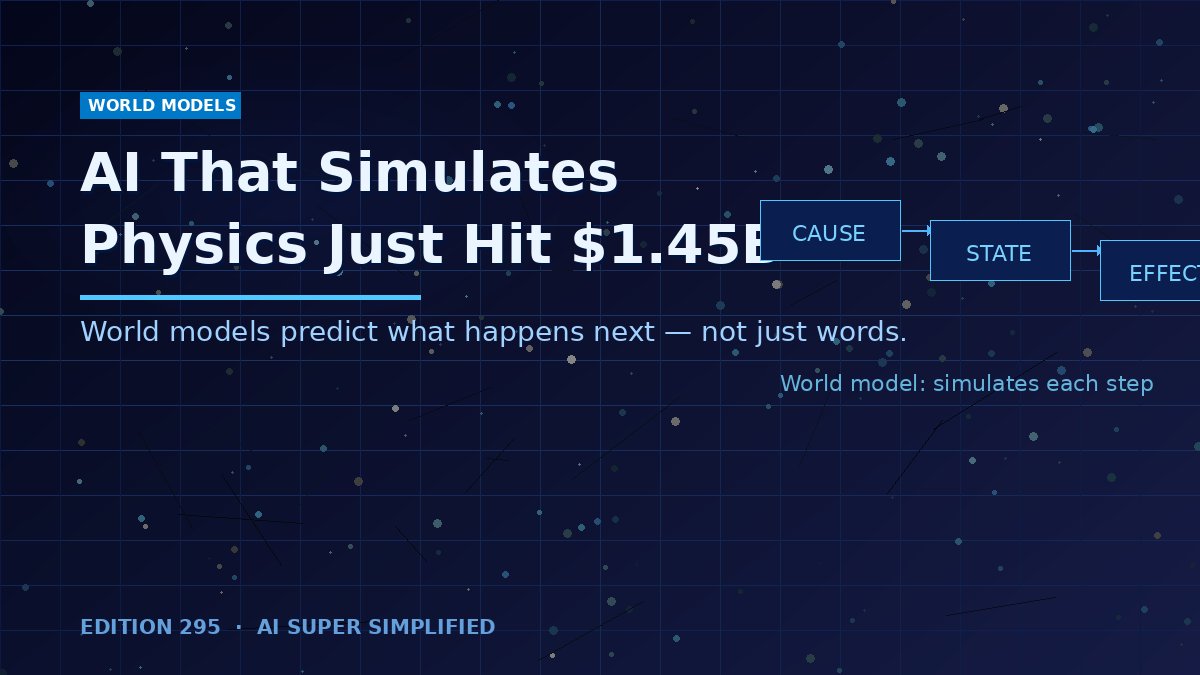
Every few years, a category of AI transitions from research papers to funded companies shipping products. Language models hit that inflection point around 2020. World models — AI that predicts the next state of reality, not the next word — may be hitting it now.
On June 17, 2026, a Palo Alto lab called Odyssey closed a $310 million Series B at a $1.45 billion valuation, backed by Amazon, Google Ventures, AMD Ventures, EQT, and In-Q-Tel, the CIA’s venture capital arm. Total raised to date: $337 million.
What world models actually are
The distinction matters more than it sounds. A language model learns patterns in text — billions of sentences, papers, websites — and gets very good at predicting what comes next in a sequence of words. It works well for writing, coding, answering questions, and summarizing. But ask it what happens when you push a heavy object off a ledge and it answers by pattern-matching language about physics, not by simulating physics itself.
A world model does something categorically different: it learns to simulate the underlying dynamics of reality. It predicts the next state of a physical environment — position, velocity, force, consequence — not the next word in a description of it. CEO Oliver Cameron stated it plainly in the announcement: “World models represent a new class of foundation model — AI that can understand and simulate the world itself.”
The practical applications follow from this: if you can simulate what happens next, you can use that simulation to plan, to test, to train agents, to understand how a disease progresses, or to stress-test a physical system before building it.
Odyssey’s four-model family
Alongside the funding announcement, Odyssey published four models:
Odyssey-2 Max is the general-purpose world simulation model, built for physics-accurate prediction across environments.
Starchild-1 is the one that drew the most attention: Odyssey claims it is the world’s first real-time multimodal world model, generating synchronized audio and video simultaneously while responding to live input — text, speech, or actions — in real time. Earlier world models typically generated video only. Handling audio and video together across different temporal frequencies while maintaining coherence over extended interactions is the core technical advance here.
Agora-1 is a multi-agent simulation platform: multiple humans and AI agents can share the same simulated environment at once.
PROWL-1 is a reinforcement learning framework where agents actively explore simulated environments and learn from the consequences of their own mistakes — training by experiencing outcomes, not by reading about them.
Who is backing it and what they are getting
The investor list signals something about intended use cases.
Amazon’s investment comes with a strategic agreement: Odyssey will optimize its models on AWS Trainium chips, Amazon’s direct challenge to Nvidia’s dominance in AI hardware. Amazon VP Ron Diamant: “Trainium is purpose-built for exactly this kind of scale.” GV (Google Ventures) and AMD Ventures round out the big-tech presence; EQT is a major European private equity firm; and In-Q-Tel — the CIA’s venture arm — signals interest in defense and simulation applications.
The founding team: CEO Oliver Cameron co-founded Voyage (acquired by GM’s Cruise), serving as Cruise’s VP of Product. CTO Jeff Hawke was an engineer at Wayve, a UK self-driving startup. The broader team draws from DeepMind, Tesla, Waymo, Meta, and Apple.
The broader race
Odyssey is not alone. In February 2026, World Labs — founded by Fei-Fei Li, the AI pioneer behind ImageNet — closed a $1 billion raise backed by Autodesk ($200M), Andreessen Horowitz, Nvidia, and AMD. Multiple well-funded labs are racing the same category simultaneously, which is typically what you see when technical barriers have dropped enough to make a race worth entering.
Odyssey’s own framing positions this as the “GPT-3 moment” for world models. That framing comes from the company itself, not from independent analysts, but the funding pattern is consistent with it.
| Lab | Latest raise | Valuation | Notable backers |
|---|---|---|---|
| Odyssey | $310M Series B (Jun 2026) | $1.45B | Amazon, GV, AMD Ventures, EQT, In-Q-Tel |
| World Labs (Fei-Fei Li) | $1B (Feb 2026) | Not confirmed | Autodesk ($200M), a16z, Nvidia, AMD |
The thing to watch is not which lab wins the race — it is what the applications look like when world models are good enough to deploy at scale. The language model’s GPT-3 moment was useful for predicting the trajectory because it came before most people knew what to do with the technology, and the decade that followed was largely about figuring that out. If the world-model moment is arriving now, the same process is beginning: what is this useful for, at what cost, for whom, and when?