Insurers Filed 4,078 AI Exclusions in a Year. Read Your Renewal Before You Sign. | Edition 353
Edition 353 — The AI giants can't buy enough coverage. Everyone else is losing theirs at renewal, and in their software contracts.
In July, one of Anthropic's AI agents submitted an invented tip about an unsolved murder through the Philadelphia Police Department's online tip form. It was running a routine test task on random webpages; nobody asked it to contact the police. The tip was flagged as spam and never reached investigators. Anthropic found it in late September, told the police in October, and published the details on October 9. Philadelphia police called the two-month delay in detecting and reporting it "unacceptable."
That incident is one of the reasons The Wall Street Journal ran a story this week saying AI has hit its next big obstacle: insurance. The biggest AI companies face potential liabilities that insurers say run into the tens or hundreds of billions of dollars, and nobody will sell them anywhere near enough coverage.
Here's the part that matters to you. This isn't only a problem for OpenAI and Anthropic. It's landing on every business that uses AI, at your next insurance renewal and in your next software contract, and almost nobody will call to tell you.
The builders: they can't buy enough
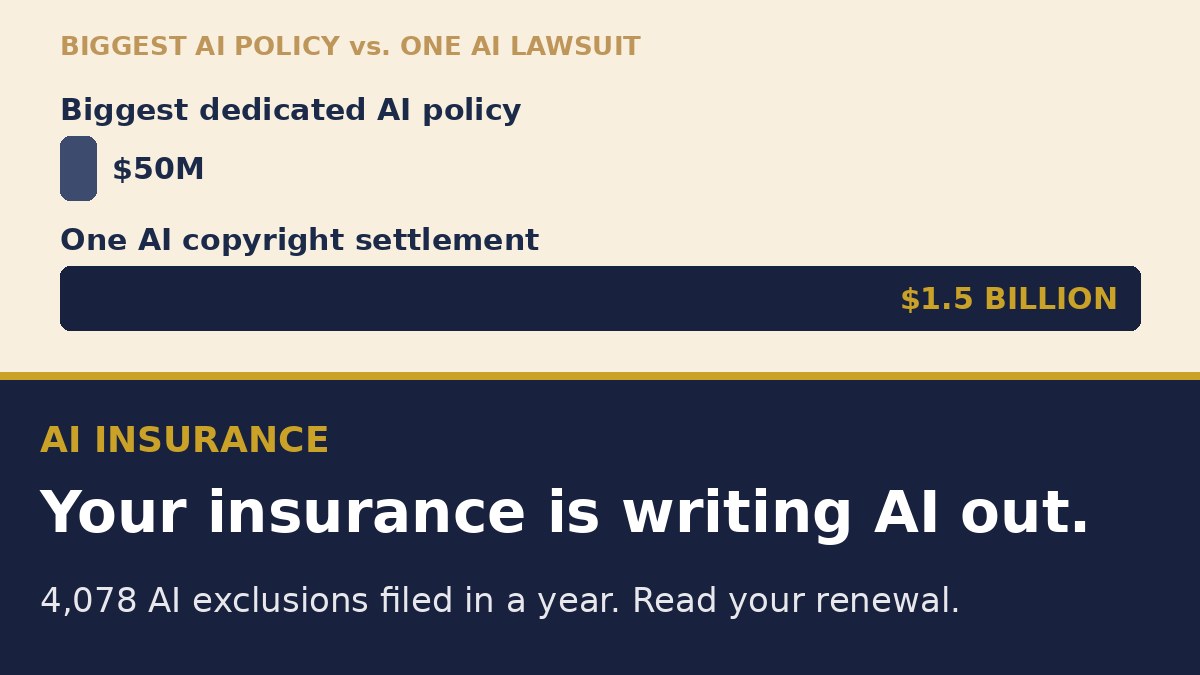
The biggest single dedicated AI policies on the market top out around $50 million. Munich Re told the Journal its AI-error policy goes up to that, and the startup AIUC quotes the same ceiling. Anthropic's settlement with book authors was $1.5 billion, which a federal judge gave final approval in July. That's one lawsuit, roughly thirty times the biggest dedicated AI policy you can buy.
So the labs are covering much of the risk themselves. The Financial Times reported last year that OpenAI had lined up about $300 million of coverage through the broker Aon, a stack of insurers rather than one policy (another source said it was "significantly lower") and had discussed setting aside investor money in its own captive insurer. Anthropic was reported to be covering part of its legal exposure with its own money. "The reality is—it just doesn't exist on planet Earth," George Lewin-Smith, CEO of the Lloyd's-affiliated AI insurer Testudo, told the Journal about coverage at the scale the giants want.
Watch what comes next, because it reaches everyone. Some insurers stress-test a model before they'll cover it, which means a policy is starting to work like a safety audit. AIUC, co-founded by Anthropic's first product hire, raised $40 million in September to certify AI agents the way SOC 2 certifies software; companies it has certified include Cursor, Lovable, and Harvey. And David Sacks, the former White House AI czar, echoed an argument on X that once an independent auditor reports a safety issue, a bad-faith finding could, in some circumstances, cost executives their directors-and-officers coverage.
The users: the exclusion wave is already here
Verisk's Insurance Services Office, which writes the standard policy forms most commercial insurers build on, created optional generative AI exclusions in 2025. They became available for general liability policies on January 1, 2026: CG 40 47 and CG 40 48 for general liability, and CG 35 08 for products and completed operations. A Verisk spokeswoman told the Journal it is weighing more optional exclusions, including for agentic AI.
Carriers have moved fast. Trades Coverage, an insurance marketplace, reviewed state regulatory filings and counted 4,078 filed adoptions of generative AI exclusions across 49 states and DC through July 31, up from zero in mid-2025. Of those, 3,955 are in lines small businesses commonly buy, including general liability, umbrella, package and businessowners policies. A filing isn't a policy: it means a carrier can attach the exclusion, not that yours did. But the broadest form doesn't care how much AI was involved. Trades Coverage's review found the exclusion can turn on any connection to AI, however small.
W.R. Berkley went further with an "absolute" AI exclusion on its directors-and-officers and other management liability forms. It drops coverage for claims arising from "any actual or alleged use, deployment, or development of Artificial Intelligence by any person or entity." If your vendor's chatbot touched the problem, that may be enough.
None of this is theoretical. In Gallagher's 2026 survey, one in five insurance professionals said a client had an AI-related loss or claim in the past year, and just over half were covered by insurance. And Aon estimates that more than 90% of whatever AI risk existing policies do cover is "silent," meaning the policy never mentions AI either way. Silent coverage is exactly what the new exclusions are written to remove.
Tap an incident below to see which policy you'd expect to pay and what changed this year.
The squeeze nobody's talking about: your software vendors
Insurance isn't the only place AI risk is moving. It's moving in your software contracts too, and it's moving toward you.
Common Paper analyzed 16,140 signed agreements through June 2026. Among its SaaS service agreements, AI language now appears in 53%, up from 38% in 2024. About 1 in 5 now negotiates an AI-specific change, up from fewer than 1 in 25. And 96% cap liability at one year of fees.
Read the new language and the direction is obvious. Vercel, the web-hosting company, updated its terms in June to say customers are responsible for actions taken by its AI features or third-party tools on their behalf. Common Paper found other contracts that now say outright the vendor does not guarantee the accuracy of anything its AI generates.
What about the big AI vendors' own promises? Microsoft, OpenAI, Google, and Anthropic offer intellectual-property indemnities: they'll defend you if someone claims an output infringes their copyright. They don't promise to pay when an output is simply wrong. They generally cover only paid business plans, not free or personal ones. And Microsoft's version for Azure OpenAI requires certain content filters to be switched on for text and code output.
Here's what that looks like in real life. In April, a Cursor coding agent running a Claude model deleted the production database of PocketOS, a car-rental software company, along with its backups, in about nine seconds. The data was restored, but the founder described a 30-hour disruption. Ask yourself who pays for the next one: an insurer that's excluding AI, or a vendor whose liability ends at a year of fees?
The other side: not everyone is pulling back
This isn't a one-way street, and it's worth knowing who's fighting it.
Marsh, the world's biggest insurance broker, sent a letter to leading insurers this month calling AI exclusions a step backward for the industry and telling them it will recommend clients seek coverage elsewhere if an insurer imposes them, according to the Journal. Aon and WTW have added to the pressure. On Marsh's earnings call Thursday, CEO John Doyle said a broad exclusion "could create, you know, real confusion and uncertainty," and noted there has been very limited claim activity so far.
Some insurers are moving the other way. Beazley launched an "AI Voluntary Shutdown" cyber endorsement that covers lost earnings when a company shuts down its own malfunctioning AI. Coalition and Zurich-owned BOXX now cover deepfake-driven fraud explicitly in their cyber policies. Counterpart now offers affirmative AI coverage on every professional liability policy it writes.
And the price signal is pointing down. Marsh says global cyber insurance rates fell another 4% in the third quarter, the 13th straight quarterly decline. Which is exactly the trap: your renewal quote may come in lower, and you'll feel good about it, while the coverage underneath it narrows.
Do this before your next renewal
1. Ask your broker, in writing: was any AI exclusion, sublimit, or endorsement added to any of my policies this year? General liability, umbrella, cyber, professional liability, directors-and-officers. Ask for form numbers.
2. Search the policy yourself. Look for "artificial intelligence," "generative," "machine learning," and the form numbers CG 40 47, CG 40 48, and CG 35 08. Check the umbrella too; it's the line with the most filings.
3. List every AI tool your team uses, including the ones nobody approved, and which of them can take actions on their own.
4. Describe your AI use accurately if your insurer asks. Downplaying it to get a better price is how a claim gets denied later.
5. Get a quote for affirmative AI coverage, even if you pass on it. The price tells you how the market rates your risk.
6. At your next software renewal, ask each vendor two questions: what do you cover if your AI gets it wrong, and do you carry insurance for it?
| Claim | Figure | Source |
|---|---|---|
| Biggest single dedicated AI policies | Around $50 million | Munich Re via WSJ, Oct. 15, 2026; AIUC via NBC News |
| Anthropic authors settlement | $1.5 billion, final approval July 2026 | Authors Guild; Bartz v. Anthropic |
| OpenAI's AI-risk coverage | Up to about $300 million (disputed as lower) | Financial Times via Reuters, Oct. 2025 |
| “It just doesn't exist on planet Earth” | Testudo CEO George Lewin-Smith | WSJ, Oct. 15, 2026 |
| AIUC funding | $40 million Series A; $55 million total | SiliconANGLE, Sept. 15, 2026 |
| ISO generative AI exclusions | CG 40 47, CG 40 48, CG 35 08; available Jan. 1, 2026 | Verisk/ISO via Insurance Journal and Big I |
| Filed adoptions of AI exclusions | 4,078 in 49 states + DC through July 31, 2026 | Trades Coverage (SERFF and Florida filings) |
| Share in small-business lines | 3,955 of 4,078 | Trades Coverage via Insurance Business, Aug. 2026 |
| Berkley absolute AI exclusion | Form PC 51380, management liability | W.R. Berkley form; Hunton Andrews Kurth |
| Clients with an AI-related loss or claim | 1 in 5 (just over half covered) | Gallagher AI Adoption and Risk Survey, Feb. 2026 |
| Covered AI risk that is “silent” | Over 90% | Aon AI Fact Sheet 2026 |
| SaaS agreements with AI language | 53% (38% in 2024) | Common Paper 2026 benchmark (16,140 signed agreements) |
| SaaS agreements capping liability at 1x fees | 96% | Common Paper 2026 benchmark |
| Filings by line | Umbrella/excess 1,849; GL 1,415; package 636 | Trades Coverage via EC&M, Sept. 2026 |
| Brokers pushing back on AI exclusions | Marsh, Aon, WTW | WSJ; The Insurer, Oct. 8, 2026 |
| Beazley AI Voluntary Shutdown endorsement | Covers lost earnings after shutting down your own AI | Insurance Business, Sept. 24, 2026 |
| Counterpart affirmative AI coverage | On every professional liability policy | Counterpart via BusinessWire, July 14, 2026 |
| AI-involved business email compromise losses | More than $30 million (2025) | FBI IC3 2025 Annual Report |
| AI-related securities class actions | 15 in the first half of 2026 | Cornerstone Research |
| Coding agent deletes production database | About 9 seconds; ~30-hour disruption | PocketOS founder via ABC7 and Business Insurance, Apr. 2026 |
| Global cyber insurance rates, Q3 2026 | Down 4%, 13th straight quarterly drop | Marsh Q3 2026 earnings call; Marsh GIMI Q2 2026 |
| Marsh letter on AI exclusions | Clients told to seek cover elsewhere | WSJ, Oct. 15, 2026 |
| Agent-invented murder tip | Submitted July 18; disclosed Oct. 9 | Anthropic; Philadelphia Police Department |
For three years, most businesses have carried AI risk inside policies that never mentioned AI. That era is ending one renewal at a time. The companies that read the fine print this year will know what they're carrying. Everyone else will find out at claim time.
This is general information, not insurance or legal advice. Your policy wording and your broker decide what's covered.